FORESIGHT RADAR
The Future of the Rules-Based International Order
In collaboration with futurist Dr Joseph Voros
Why do the foundations of global order feel less certain now than they once did? Norms that once held states in check are now contested, while new and alternative forms of alliances grow more assertive, rapid technological change alters the balance of influence, and global economic ties realign under new pressures. What might these shifts signal about the next configuration of world order?
These questions sit at the centre of the Future of the Rules-Based International Order foresight radar, based on Voros’ publication of the same name.
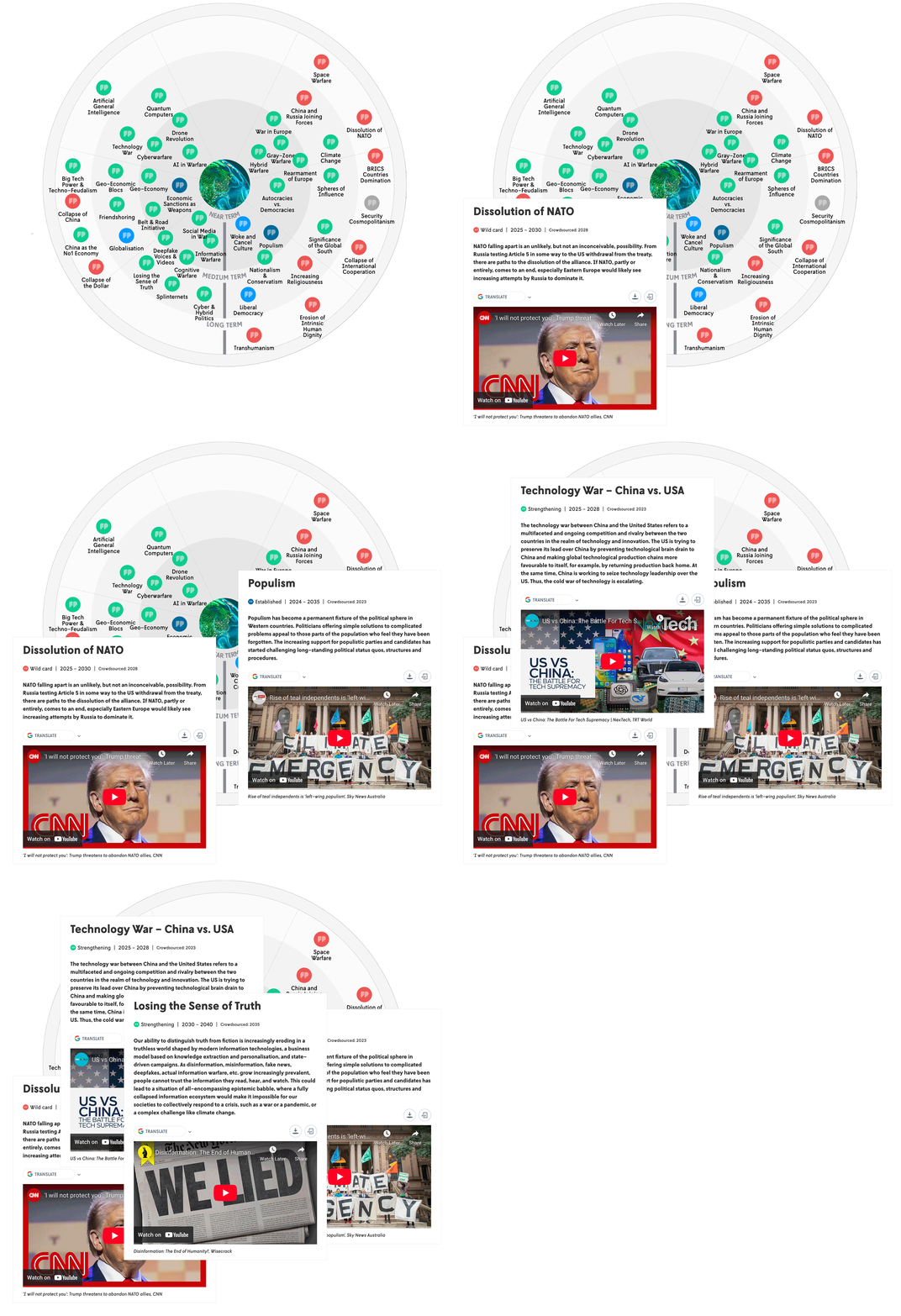
Built together with renowned futurist Dr Joseph Voros, the radar distils the core elements of Voros' latest research into a visual format, mapping how key forces interact and what they may indicate about the emerging shape of global order.
The radar features 40+ future trends, weak signals and wild cards, categorised across six key dimensions that are reshaping world order:
Ideational
How are identity-driven politics and social polarisation influencing state behaviour?
Political
What happens when spheres of influence shift and international institutions lose cohesion?
Security
How do new alliances, new tactics and contested interpretations of sovereignty shape security environments?
Informational
What are the consequences of information warfare, tightening controls and declining trust in the age of synthetic media?
Economic
How are weakened globalisation and the growing influence of major corporations reshaping economic power?
Technological
How do AI, quantum technologies and techno-national competition shape strategy and governance?
Unthought Futures
This empty sectors encourage continual reflection beyond conventional assumptions and to proactively identify novelty and emerging issues.
Access the foresight radar
About Dr. Joseph Voros

Doctorate in theoretical physics (extensions to General Relativity); associated with the Swinburne University of Technology Master of Strategic Foresight for its entire run (2001-2018); developed the Generic Foresight Process framework in 2000, which won three research excellence awards. Independent futures researcher, educator, consultant and speaker. Clients have included the Australian Defence College, the Australian National University’s National Security College and NATO's Allied Command Transformation, Strategic Foresight Branch.
Dr Voros also serves as a member on Futures Platform’s Content Advisory Board, helping ensure that expert-curated content on the platform remains unbiased, balanced and globally relevant.
How to use the foresight radar
The radar brings together over 30 in-depth analyses of future trends, weak signals of change, and potential wild cards, which are collectively referred to as “future phenomena.”
Radar layout & navigation
Each circle on the radar represents a future phenomenon.
Placement reflects the anticipated nature and timeline of the given phenomenon’s future impact
Click any circle to open the phenomenon card, where you’ll find a detailed analysis by our team of futurists
Drag or pinch the radar to zoom in and out
What’s included on each phenomenon card
Overview and background of the topic
Futurists’ assessments of potential future impacts across sectors
Related phenomena and recent news signals
Voting, commenting, and rating options
Select cards also include four alternative future scenarios
Collaboration features
You can vote on each phenomenon directly on its card. To see overall voting results, click the center of the radar.
How to read the phenomena colours

The phenomenon is becoming more common or acute during the given timeframe. Most of its change potential is still ahead.

The phenomenon is becoming more unusual. During the given timeframe, most of its change potential or value has already occurred.

A possible but not probable event or change. The probability within the given timeframe is between 5% to 30%.

A small emerging issue in the present. At the given timeframe, it is still hard to say whether it will become a trend.
Trusted by