Envision the future of cities with a global group of experts
50+ Trend Analyses by Futurists
Gain a comprehensive understanding of how cities are poised to evolve in the decades ahead, from sustainability to technological advances, governance, urban living and more.
Interactive & Visual View of the Future
Explore the interconnections between trends in a holistic radar view and discover how one trend may catalyse a domino effect of change within the urban ecosystem.
Collaboration Tools to Share Insights
See how the experts from across the globe have voted and rated the trends on the radar, and join in the discussion to share your view of the future with a global community.
The limited-time free access period for this radar has now ended.
Subscribe to our newsletter to be the first to know when when we publish new foresight content.
QUICK INSTRUCTIONS
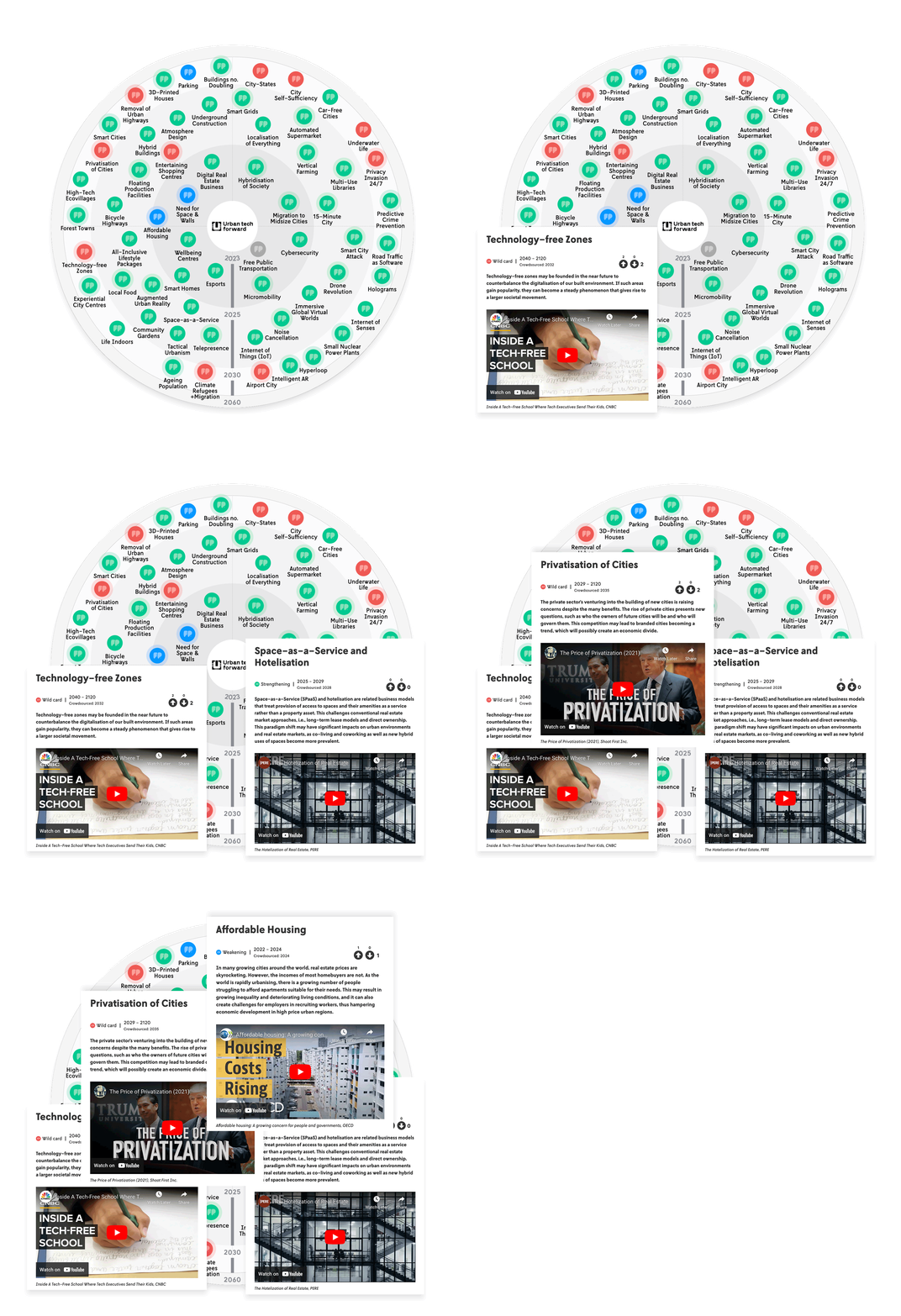
The radar brings together 50+ in-depth analyses of future trends, disruptions and drivers of long-term change. Drag or pinch radar to zoom in/out.
These analyses, called “future phenomena”, are organised under themed sectors. Click sector names to view further analysis.
Click individual phenomena to read full analysis, including intro, video, brackground, implications, scenarios, related phenomena, further information, and related news signals.
On each phenomenon card, you can both vote and rate the importance of the subject. View voting/rating results by clicking the centre of the radar.
The color of the phenomenon indicates type: strengthening, weakening, wild card, weak signal (read more below)
HOW TO USE THE RADAR
Each circle on the radar represents a future phenomenon or trend. Phenomena are placed on the radar according to the anticipated nature and scale of change they’ll go through as a result of the war. When you click the titles of each radar section, it will open a summarised, big-picture analysis of the trends in that category.
Clicking on phenomena circles will open a trend card where you can find our futurists’ analyses on the individual phenomenon and its future impacts across various sectors. In some of the trend cards, you can also find scenario descriptions that describe alternative future development paths for the given phenomenon.
Every card on Futures Platform’s foresight database is assigned a type according to its anticipated future development path. We categorise future changes into four types - Strengthening, Weakening, Wild Card and Weak Signal.
The phenomenon is becoming more common or acute during the given timeframe. Most of its change potential is still ahead.
The phenomenon is becoming more unusual. During the given timeframe, most of its change potential or value has already occurred.
A possible but not probable event or change. The probability within the given timeframe is between 5% to 30%.
A small emerging issue in the present. At the given timeframe, it is still hard to say whether it will become a trend.
READ MORE ON OUR BLOG
From biological markers to power structures, many variables shape how we understand the rhythm of societal change.
Across history, patterns of rise and fall, peace and war, innovation and decline seem to unfold in rhythms - some as short as a decade, others stretching over a century. Are there five, six, or even more distinct lengths to these societal cycles?
Complexity Theory as a Framework for Understanding Societal Transformation
What can generational theories tell us about this shift?
The cost of Ukraine's reconstruction stands at a staggering $486 billion—and climbs higher with each passing day. Timely decisions on investments, workforce, and resources will define the nation’s post-war recovery and long-term future.
Drawing on in-depth foresight research by renowned futurists Prof. Sohail Inayatullah and Dr. Ivana Milojević, we spotlight five emerging issues that may revolutionise global food systems over the next 30 years.
By 2100, all of the world's 20 largest megacities will be located in the developing world, with the majority in Africa. What implications will this shift have for the future of the global economy, climate, and the welfare of these urban populations?
New players in the housing industry are stepping up with all-inclusive packaged housing in holiday destinations ranging from old-world glamour to modern metropolis and ocean cruises – not of a lifetime, but rather, for a lifetime.
As the cost of traditional building materials rise, the construction industry may learn that going green is shifting from being too expensive to do, to too expensive not to do.
Often referred to as the ‘solo economy’ or ‘singles economy’, the growing prevalence of this household unit will have many implications for consumer brands who’ve long assumed that the default household consists of multiple people.
Along with tourism and the events industry, retail has been one of the most heavily affected sectors by the onset of the Covid-19 pandemic. Yet, despite the sudden hit, we anticipate that the retail sector will bounce back with a renewed focus on experience design and human connection.
A new wave of sustainable urbanism focuses on bringing nature into the heart of the cities.
With over one million people moving to cities every week globally, the world is currently undergoing the biggest wave of urbanisation in human history . As urban populations increase, future cities will also face an array of new challenges.
Despite the pandemic, the larger trends in the transportation industry are not going away. The need for more environmentally friendly, resilient and comfortable ways to move around will persist and reassert itself after the lockdowns have ended.
Vanlife has been a growing trend among bohemian digital nomads for the past decade, but in the future when people start travel again, the romantic hippie vehicle might be increasingly replaced by ultramodern portable homes with more convenient facilities. And where the world once was an oyster for travellers, it is possible they will now be happy only with a slice of that: their local hoods and woods.
3D printing and Hyperloop may not seem an obvious combination. Still, they may help in easing the tight housing market and provide more flexibility and options to live in different sized cities.
Last-mile delivery usually refers to the transportation of goods from a transportation hub (such as a warehouse) to the final destination (consumer's homes). It might not sound like an area that particularly favors a lot of innovation – but it does. In this article, we explore why it matters.
About 90% of the world's commodities are carried by the international shipping industry, annually. Liner shipping also transports around USD 4 trillion of goods yearly. There are more than 8,000 thousand of ports in over 200 countries worldwide. Here are their current challenges and future trends.
For many, Africa may seem like a continent with a sealed fate. But Africa is a vast continent, replete with nations growing and developing rapidly. Despite challenges that continue to assail it, Africa seems set to play an increasing role in world affairs. The question is, will African nations be able to follow the example of many Asian nations and do it sooner rather than later?
You take off from home, get in your car, arrive at the company office, take the elevator, and sit at your desk. For most white-collar workers, that used to be a typical routine. You get your work done at your desk in the company's offices. But in the past couple of years there has been a growing trend toward co-shared office spaces. In this article, have a look at this trend.
It's estimated that by 2050, global food demand will increase between around 60% to 100%. We're already seeing some efforts at making rural areas more efficient at crop production. Laboratories are now attempting to lab-grown meat and other methods. Another promise, which has been frequently evoked lately, is vertical farming. But what exactly is it?
Rural areas are plagued with dwindling populations, lack of job opportunities, inadequate education, inferior healthcare services, and much more. In the 21st century, however, we have the opportunity to turn some of this around. Making the Countryside Smarter. How it might survive in a rapidly urbanizing world
Retail has become a digital experience, far more optimized, quick, and personalized. That's not to say that physical retail is disappearing - far from that. In this article, we look at the future of retail through technology, business and value chains, the service industry, values and social responsibility, and the global economy.
EBOOK
FUTURES INTELLIGENCE: HOW TO TURN FORESIGHT INTO ACTION
GET AHEAD OF ACCELERATING CHANGE
Discover a versatile set of foresight methods ranging from scenario planning to sci-fi prototyping, and learn how they can be applied to strategy, innovation and risk management processes with this practical guide to Futures Intelligence.
Before the world caught on, Givaudan was already designing the taste experiences of tomorrow. We sit down with Igor Parshin, Customer Foresight Lead at Givaudan to talk about how the company uses foresight to turn early change signals into the flavours that will define the future.