WEBINAR
The next decade in five trends, four scenarios, one stress test
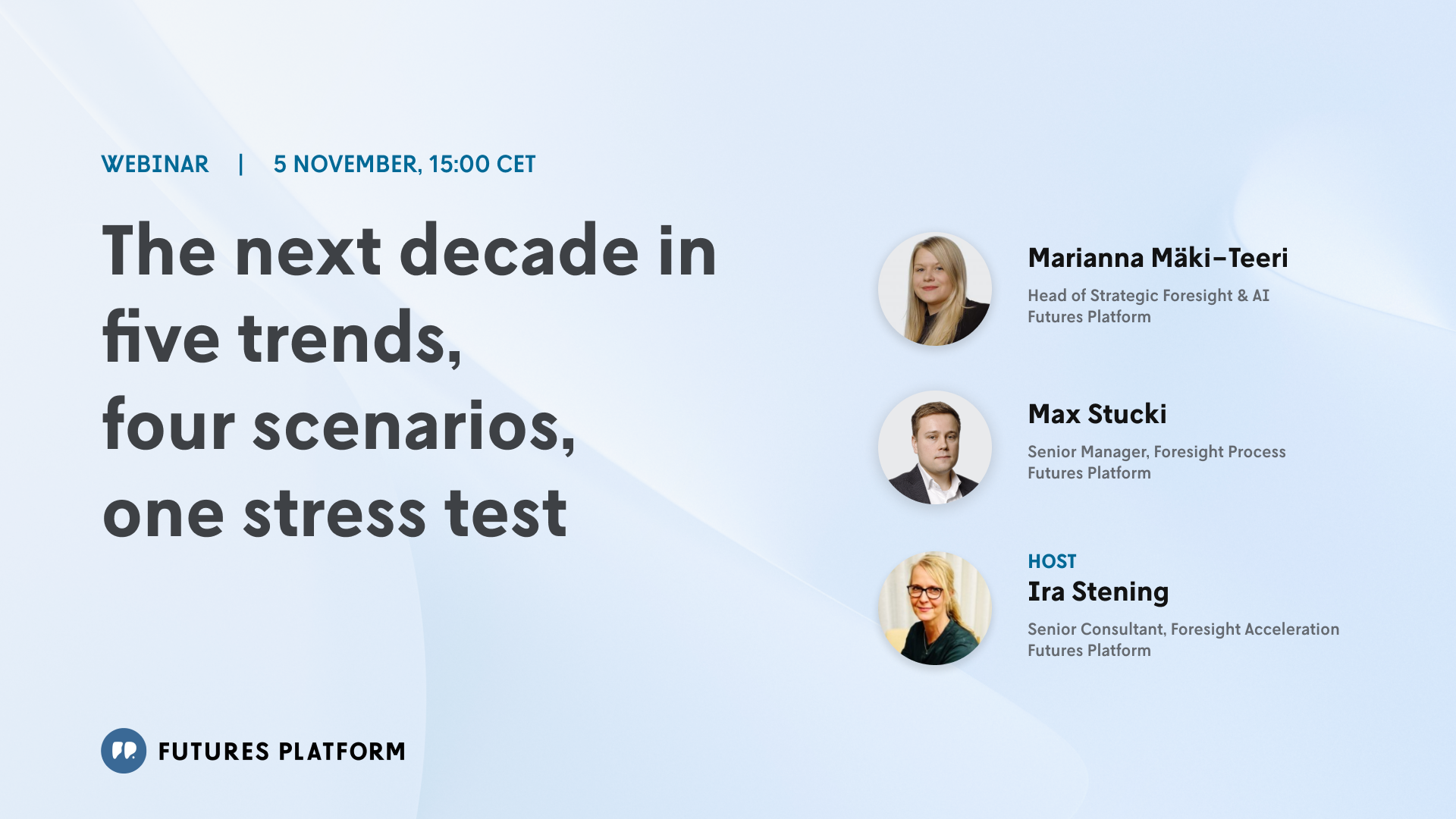
2036 is nearer than it sounds.
A strategy written this year will spend its life in conditions nobody has seen yet. It will hire from a labour market that works differently, operate under rules that have since split apart, and sell to customers who decide what is real before they decide what to buy.
In the first half of the session, our futurists take a closer look at five trends they are watching closely for the decade ahead. Where each one stands today. What has to happen for it to accelerate. Which industries feel it first, and which have longer than they think.
The trends on the table
The end of the labour surplus. Forty years of strategy assumed people would be there. Ageing economies and closing borders are rewriting that assumption. Scarcity moves from capital to people.
Software that acts. AI stops drafting and starts doing. The open questions are about liability, insurance and decision rights.
One company, several rulebooks. Fragmenting standards across data, AI, emissions and payments are making a single global operating model expensive to maintain.
The verification economy. When synthetic content is cheap and convincing, proof of origin starts to carry a price.
From cutting emissions to coping with consequences. Insurers withdrawing, water limiting where you can build, infrastructure designed for a climate that no longer exists.
The second half turns to what a strategy team does with any of this.
We take the two trends carrying the deepest uncertainty and cross them into four alternative futures. Then we run one recognisable strategy through all four and see where it holds. A plan built for a single expected future tends to look sound right up until the moment it is tested. Four futures make its weak points visible while there is still time to act on them.
Bring a strategy of your own and you will leave with a method you can apply to it directly.
What you take away
Five drivers of change our futurists are tracking, with the reasoning and the timing behind each
How to turn any change driver into alternative future scenarios your team can work with
A method for stress testing a strategy already in motion: closing the gap that most organisations struggle with
Register for the webinar
Trusted by