
WHITEPAPER
Futures Intelligence:
Closing the Gap between Insight and Future-Fit Decisions
A new integrative capability that brings different forms of future-related insights in one connected sense-making flow to turn them into shared, decision-ready understanding
Over the past decade, organisations have significantly expanded their ability to anticipate and analyse future change. Future-focused insight work has become more widespread across functions, from strategic foresight and market intelligence to innovation, risk, and consumer insight.
This expansion reflects a rational response to a more volatile environment. Change now unfolds faster, across more dimensions, and with greater uncertainty than many organisational decision models were designed to handle.
Yet despite these growing capabilities, clarity often remains elusive when strategic decisions need to be made. Between insight and action sits a layer of work that is often under-designed, unevenly distributed, and rarely shared. That layer is sense-making.
What is missing is an integrative capability that helps organisations work with insight once it exists. A way of connecting different forms of future-related knowledge and bringing them together at the moment strategic decisions are made.
This whitepaper sets out the case for Futures Intelligence as a new, structured way of working with the future. One that helps organisations integrate the insight they already produce, translate it into direction, and make confident, future-fit decisions in the face of ongoing uncertainty.
Download the whitepaper
In many organisations today, future-related insight is often produced close to decision-making, but not inside it. Insight informs discussion, shapes perspective, and broadens understanding, yet does not consistently translate into direction. In practice, it becomes adjacent rather than applied.
The Gap Between Insight and Decision

Fragmentation limits shared understanding
Multiple functions generate insight with different mandates:
Foresight teams explore long-term scenarios
Market intelligence tracks competition
Strategy teams set direction
Innovation scans opportunities
Risk assesses exposure
Result: Parallel interpretations rather than shared understanding
Noise increases volume without clarity
Future-related information arrives from many directions at once:
Signals, trend reports, and analyses accumulate continuously
Not all inputs carry the same relevance or reliability
Volume can outpace interpretation
Result: Attention fragments, priority becomes harder to establish
Trust and bias are harder to assess as sources multiply
Judgement is shaped implicitly:
Reliance on experience or institutional authority rather than shared criteria
Differences attributed to opinion, not assumptions
When trust decisions remain implicit, organisations struggle to learn from disagreement
Result: Some insights are overlooked, while others gain influence by default.
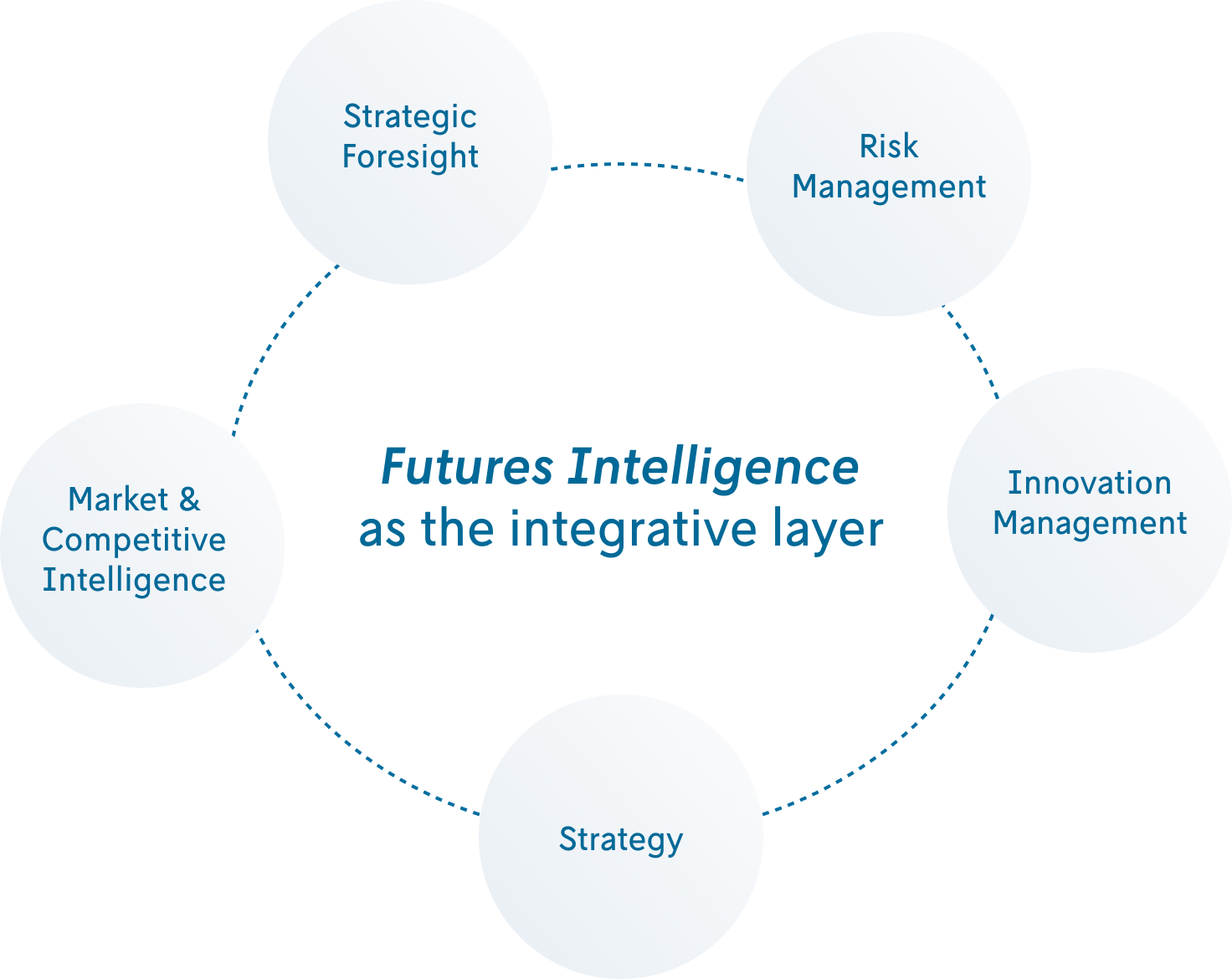
“Futures Intelligence gives structure to the work that already happens across different teams by connecting their outputs, surfacing contextual implications, and making their insights usable at the point where decisions take shape.”