Explore the future of defence with a global community of experts
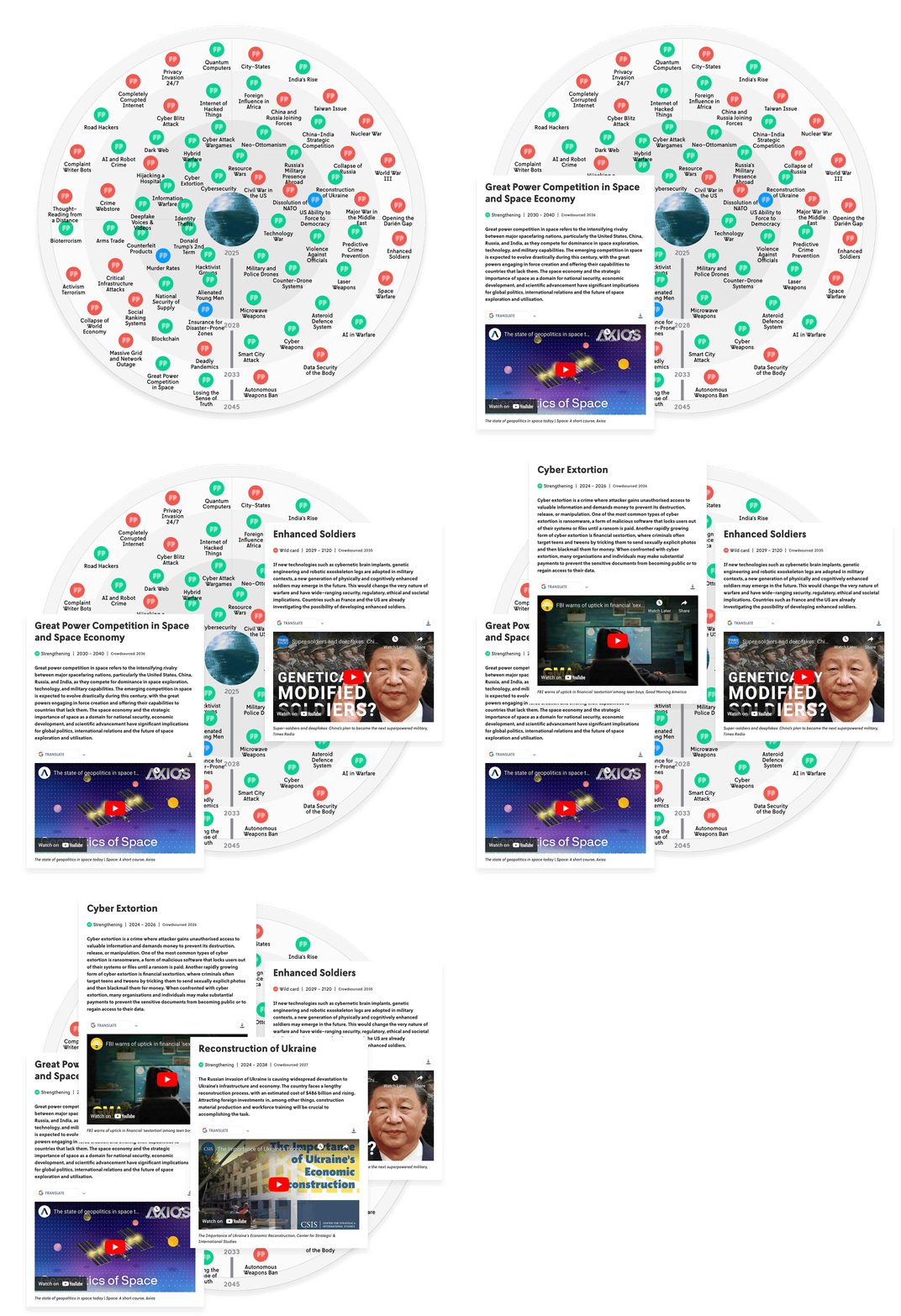
Strategic foresight radar curated by Futures Platform’s team of professional futurists
Trend Analyses by Futurists
Explore over 50+ trends and change drivers shaping the future of defence, including advancements in technology, evolving geopolitical dynamics, cybersecurity, governance frameworks, and strategic partnerships.
Interactive & Visual View of the Future
Explore the interconnections between trends in a holistic radar view and see how one trend may catalyse a domino effect of change across systems.
Collaboration Tools to Share Insights
See how other industry experts have voted and rated the trends on the radar, and join in the discussion to share your vision on the future of defence and security.
Access the radar
Quick Instructions
The radar brings together 50+ in-depth analyses of future trends, disruptions and change drivers. Drag or pinch the radar to zoom in/out.
These analyses, called “future phenomena”, are organised under four themes. Click theme names to read further, macro-level analysis of each.
Click individual phenomena to read the full analysis, including intro, video, background, implications, scenarios, related phenomena, further information, and related news signals.
On each phenomenon card, you can both vote and rate the importance of the subject. View voting/rating results by clicking the centre of the radar.
The colour of the phenomenon indicates type: strengthening, weakening, wild card, weak signal (read more below)
How to use the radar
Each circle on the radar represents a trend or an emerging change signal. They are placed on the radar according to their anticipated nature and scale of change they’ll go through in the decades ahead. When you click the titles of each radar section, it will open a summarised, big-picture analysis of the trends in that category.
Clicking on phenomena circles will open a trend card where you can find our futurists’ analyses on the individual phenomenon and its future impacts across various sectors. In some of the trend cards, you can also find scenario descriptions that describe alternative future development paths for the given phenomenon.
Every card on Futures Platform’s foresight database is assigned a type according to its anticipated future development path. We categorise future changes into four types - Strengthening Trend, Weakening Trend, Wild Card and Weak Signal.
The phenomenon is becoming more common or acute during the given timeframe. Most of its change potential is still ahead.
The phenomenon is becoming more unusual. During the given timeframe, most of its change potential or value has already occurred.
A possible but not probable event or change. The probability within the given timeframe is between 5% to 30%.
A small emerging issue in the present. At the given timeframe, it is still hard to say whether it will become a trend.
EBOOK
Scenario Planning: A Step-by-Step Guide
Learn how to build compelling future scenarios and transform them into future-ready strategies. Expertly guided by Futures Platform’s foresight experts and meticulously broken down into simple, actionable steps.
Read more on our blog
Defence debates tend to focus on firepower. But the most destabilising risks may come from something far harder to quantify: the fraying of social trust, the manipulation of truth, and the erosion of the middle class.
Militaries are adopting AI at speed; the real test will be keeping decisions accountable in an age of autonomous operations.
In 2022, we outlined four possible futures for the war in Ukraine. Now, three years later, as new geopolitical realities emerge, it’s time to reassess which scenarios still hold and what the latest developments mean for Ukraine, Russia, and the West.
The cost of Ukraine's reconstruction stands at a staggering $486 billion—and climbs higher with each passing day. Timely decisions on investments, workforce, and resources will define the nation’s post-war recovery and long-term future.
AI’s rapid rise in the workplace is opening up new possibilities—some optimistic, others unsettling. Our team of futurists explore how AI could alter job roles, workplace dynamics, and society at large through four distinct scenarios.
Beneath the resilient surface of the global economy lie structural challenges that could threaten its stability. We examine what could unfold in the unlikely—but not impossible—event of a global economic collapse.
By 2100, all of the world's 20 largest megacities will be located in the developing world, with the majority in Africa. What implications will this shift have for the future of the global economy, climate, and the welfare of these urban populations?
Will the trade-off between privacy and convenience become the norm in our digitised future? Or will people reclaim control, heralding a new era for the internet?
Geopolitical tensions surrounding Taiwan are reaching a critical juncture as Beijing increases political and military pressure on Taipei. We present three scenarios that explore the future of Taiwan-China relations and the implications of a potential conflict.
It's more than just a regulatory update; it's a clarion call for companies to embrace climate scenario analysis.
Called back from the brink of retirement, nuclear energy is evolving away from its radioactive reputation and filling the gaps in carbon-neutral energy plans.
Embrace a long-term perspective to strengthen your cybersecurity strategy against ever-evolving cyber threats.
Is your organisation prepared for any risk, whether large or small, imminent or eventual, avoidable or not? The time and effort put into “exploring the dark side” and developing a solid risk management framework will pay off, making your organisation well-equipped to navigate an uncertain future.
2022 was a year of great upheaval and change, with a series of political and economic crises that will reverberate for many years to come. Looking back to the year, our team of futurists highlight five trends that shaped the trajectory of 2022 and will continue to shape the future.
Population growth rates are stagnating in many countries around the world, but the economics of a declining population is still uncharted territory for modern economic theory. How will our growth-based economic systems fare when the population declines?
It may seem like there’s more technological innovation than ever today, but more innovation doesn’t necessarily mean more economic growth.
With the steep rise in volumes of counterfeit consumer goods entering the global marketplace, brands, retailers, and governments are facing new challenges.
The war in Ukraine has brought major disruption and new uncertainties to several sectors. To help organisations successfully navigate the constantly evolving environment ahead, Futures Platform’s team of futurists has outlined four different scenarios on how the war may evolve within the next five years.
Europe spent years negotiating, innovating and planning to solve its net-zero energy policy puzzle by 2050. Will Russia’s war on Ukraine reshape the future of energy in the continent?
Poor institutional performance, slow response to the global agenda, and increasing economic inequalities are among the main drivers causing a global decline in trust in public authorities and political leaders.
In this interview, our Content Director and head of the futurist team, Dr. Tuomo Kuosa, tells about the process of analysing the global impacts of the Ukraine war. He also discusses which one has a more profound impact, the war or the Covid-19 pandemic, and explains the difference between forecasting and foresight.
With the exponential growth of Asian economies, the consumption balance is shifting from the West towards the emerging markets in Asia.
While the value of data is rising, the loss of privacy in the digital era is becoming a reality. But giving up personal data requires trust: consumers need to be able to trust organisations to handle their data ethically and keep it safe from hackers, and other cyber threats – but also from the more obscure purposes organisations themselves might have.
For more than 13 years, NATO has conducted cyber wargames that simulate complex decision-making in cyberspace. The focus, along with the invitation list, has widened to include all forms of cybersecurity, and in 2020, white-hat hackers were included for the first time.