
The internet will tell you the consumer is broke, sceptical, and trying to spend less time online. Our new foresight radar suggests something bigger is going on.
FUTURE PROOF – BLOG BY FUTURES PLATFORM
When you picture the consumer of 2035, what comes to mind? Someone paying for lunch with their face? A fridge placing its own orders? The chronically online shopper being served a feed that knows them better than their partner does, buying things they had not realised they wanted until the algorithm introduced them?
Or do you picture the opposite? The dumbphone revival. The queue outside the record shop on a Saturday. The run club that replaced the dating app. The friend who went sober in January and simply never came back.
Both of these people exist, and in a lot of cases, they are the same person. The consumer who lets an AI assistant reorder their household basics is also the one paying a premium for a vinyl pressing of an album they already own, on a phone they are trying to use less, with money they are watching more carefully than they were three years ago.
Our new foresight radar, Consumer of the Future, holds all of that in one frame. It brings together 50 trends, emerging weak signals of change, and wild cards across five themes and three time horizons between 2026 and 2045.
Here is the short version of each theme, and the question we think it puts to a strategy team.
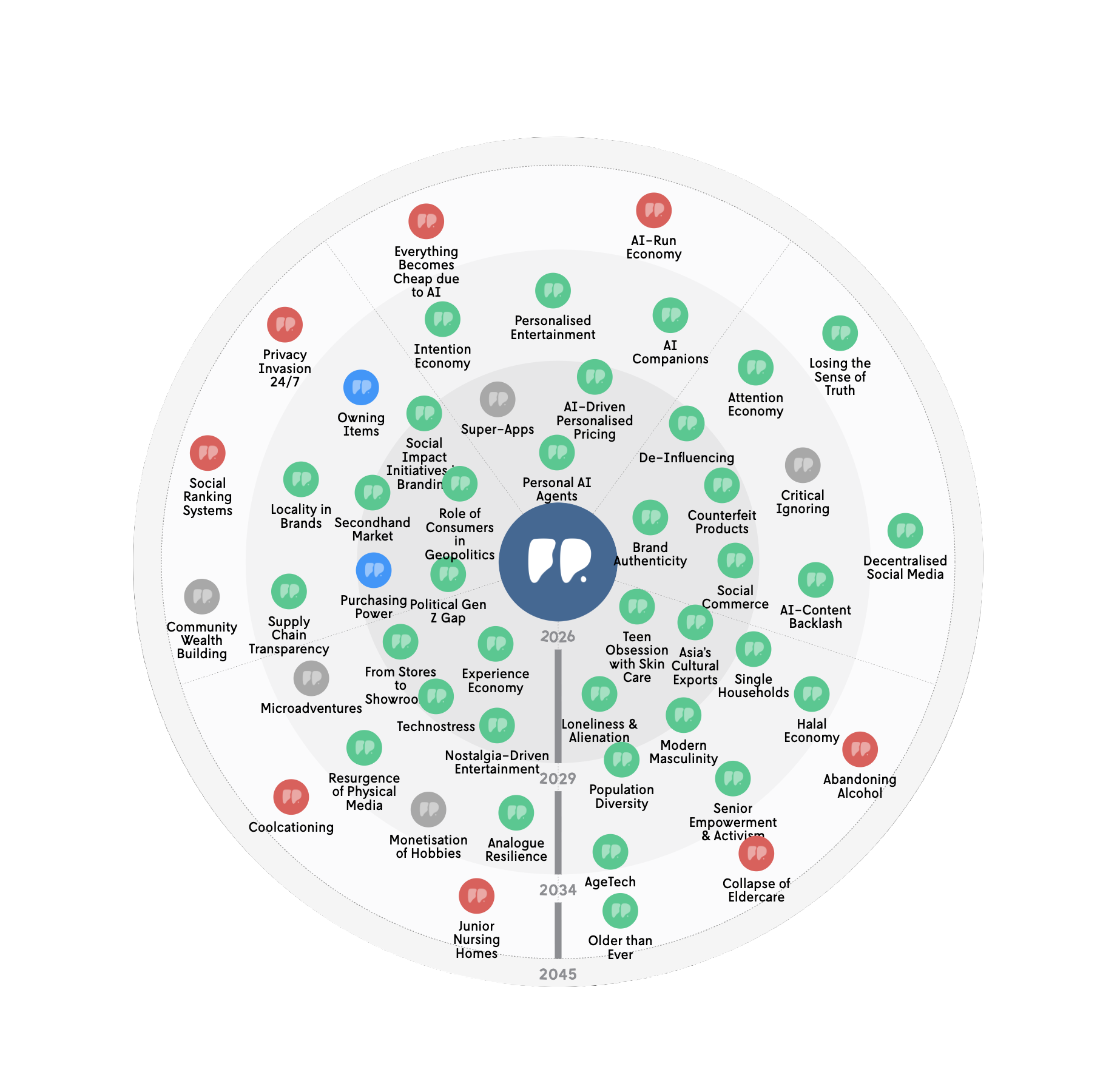
Open the full radar
All 50 trends, each with a dedicated analysis from our futurists: what is driving it, how fast it is moving, and its potential future implications for brands. Open it with the form below.
1. When AI does the shopping
For decades the industry organised itself around a single scarce resource, which was human attention. Budgets, metrics, and the entire media apparatus assumed a person at the other end who could be reached, interrupted and eventually persuaded.
That assumption may soon be expiring. There is a version of the future, already half built, in which no human looks at your packaging again. The AI agent does the looking. It compares specifications, reads the returns policy, checks delivery windows and makes a decision in the time it takes you to open a browser tab. It has no childhood memory of your brand. It did not see the campaign. It will not be charmed.
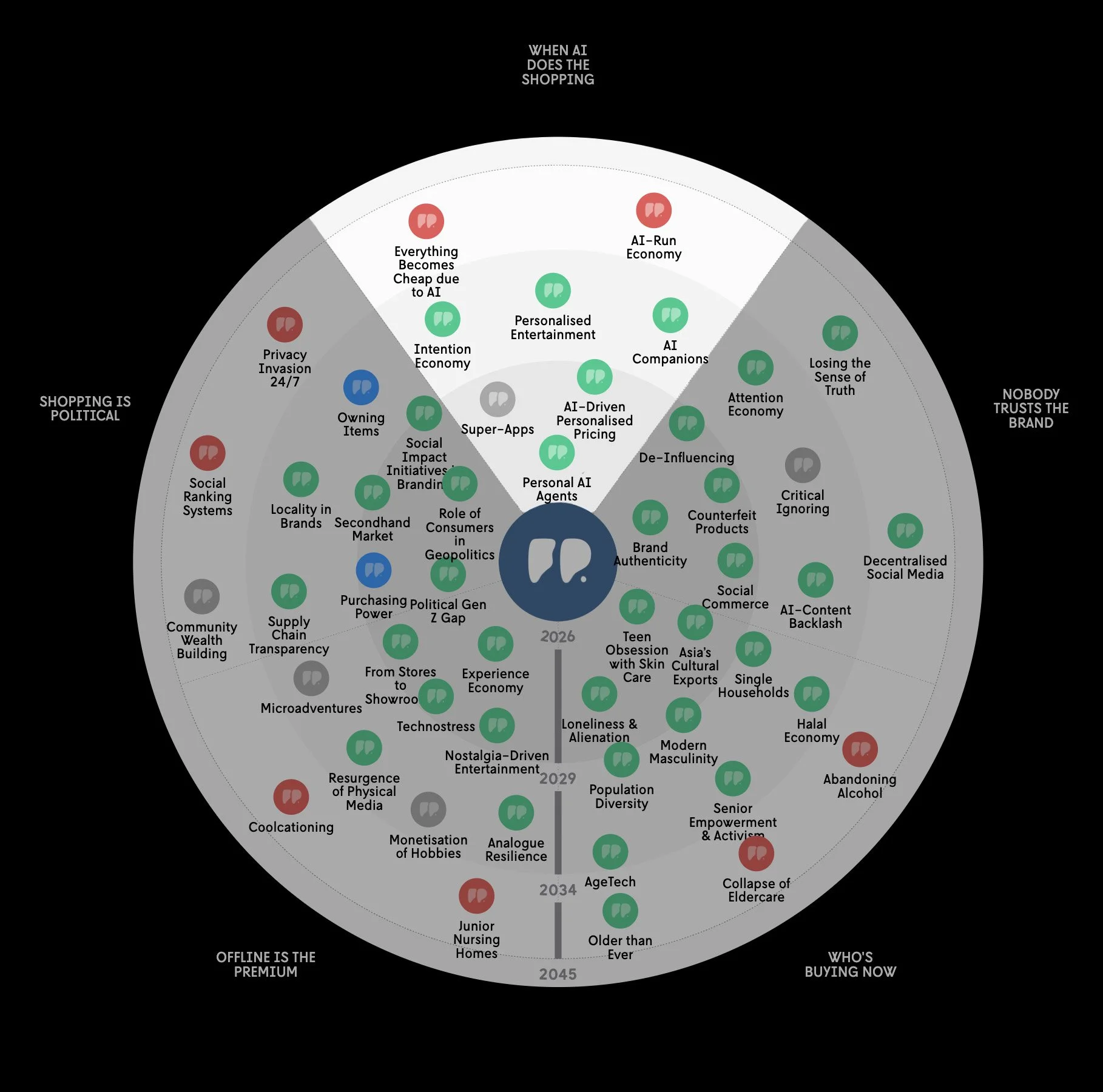
This is the part of the radar we have called When AI Does the Shopping, and the trends inside it are less about the technology than about who stands between your brand and the person paying. The trends Personal AI Agents and the Intention Economy point to a market running in reverse, where the buyer broadcasts a need and suppliers compete to meet it.
AI-Driven Personalised Pricing takes the posted price and turns it into a private negotiation. Super-Apps and Personalised Entertainment move discovery onto surfaces almost nobody in your marketing team controls, and the AI-Run Economy describes where that ends up, with the systems doing the buying and the systems doing the selling mostly dealing with each other.
For whoever is genuinely best on price, specification and delivery, this is excellent news. For everyone else, it raises new questions, as well as questions that has been easy to avoid while a human was doing the choosing.
The question: If an agent compared you on specification, price and delivery alone, which parts of your brand would survive?
2. Nobody trusts the brand
Start from the assumption that your buyer thinks you are exaggerating, because the evidence suggests they do. They assume the review was paid for, the photograph was AI-generated, and the claim has been through legal. This is not cynicism in the old-fashioned sense, and it is not a reputation problem that a better campaign can fix. It is a reasonable response to an environment where checking whether something is true costs more effort than the purchase is worth.
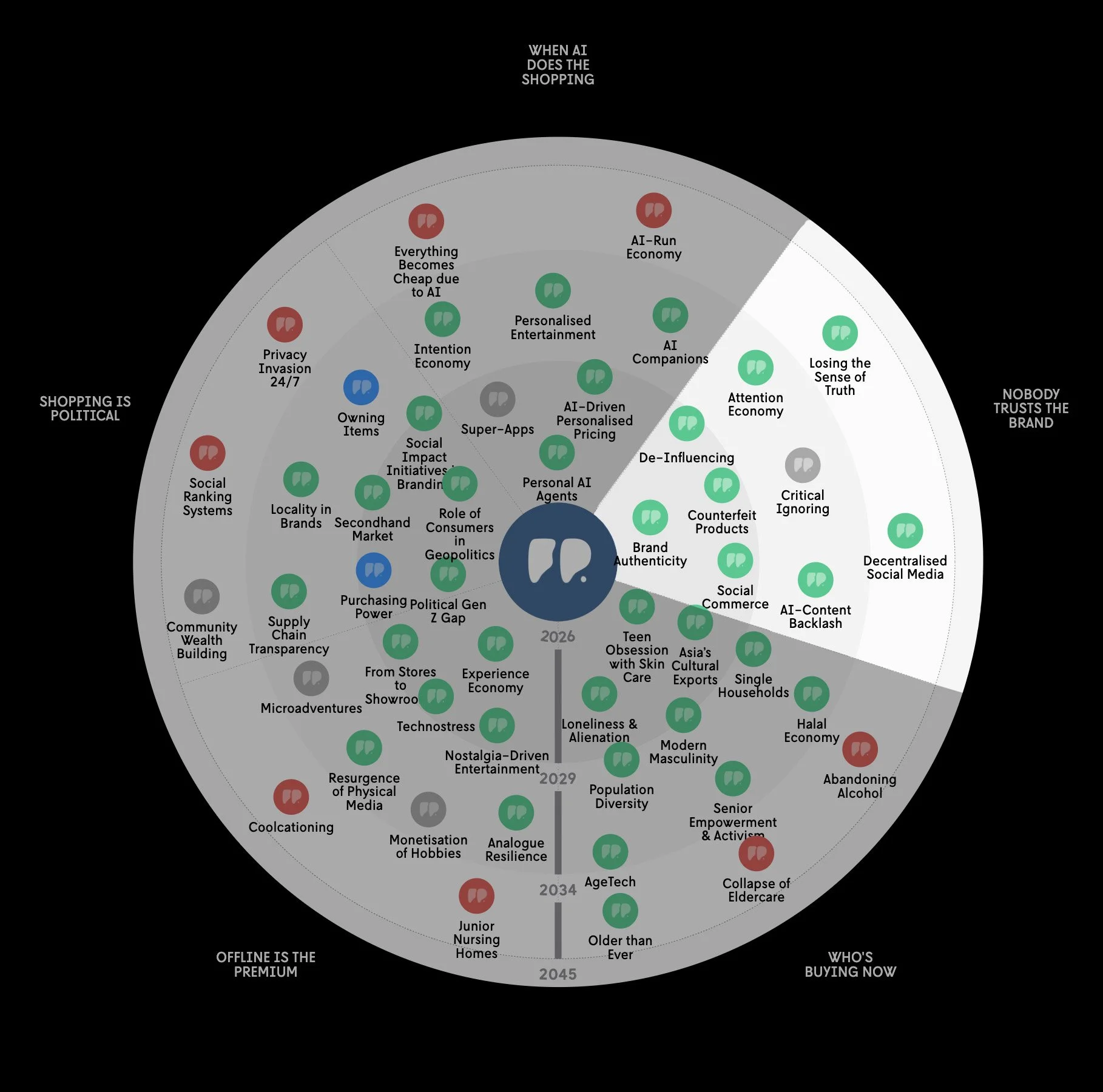
The radar tracks this from several directions at once. Trends like Losing the Sense of Truth and the AI-Content Backlash describe the supply side of the problem, where generated material has made the cost of plausible nonsense almost nothing. Critical Ignoring and the Attention Economy describe what that does to the consumer, who has become very good at filtering and very protective of their attention.
De-Influencing turns the whole persuasion industry on its head as a social media trend built entirely on telling people what not to buy. Brand Authenticity, Decentralised Social Media, and Social Commerce describe where the remaining trust goes: towards smaller rooms and trusted content creators rather than brands and big corporations.
For brands, the implications are practical. Every claim needs evidence attached to it, and proof that comes from outside the brand carries more weight than anything the company says about itself. A trusted creator the audience already follows will often be believed where a brand channel will not.
The question: What evidence would convince a consumer who assumes you are exaggerating?
3. Who's buying now
Demography is the part of the future that is already clearly visible. The people who will be buying in 2040 are alive now, their households have already formed, and the direction of travel has been visible in national statistics for years. This makes it the least speculative section of the radar and, in many categories, the one with the widest gap between what the data says and how brand and category plans actually define the target customer.
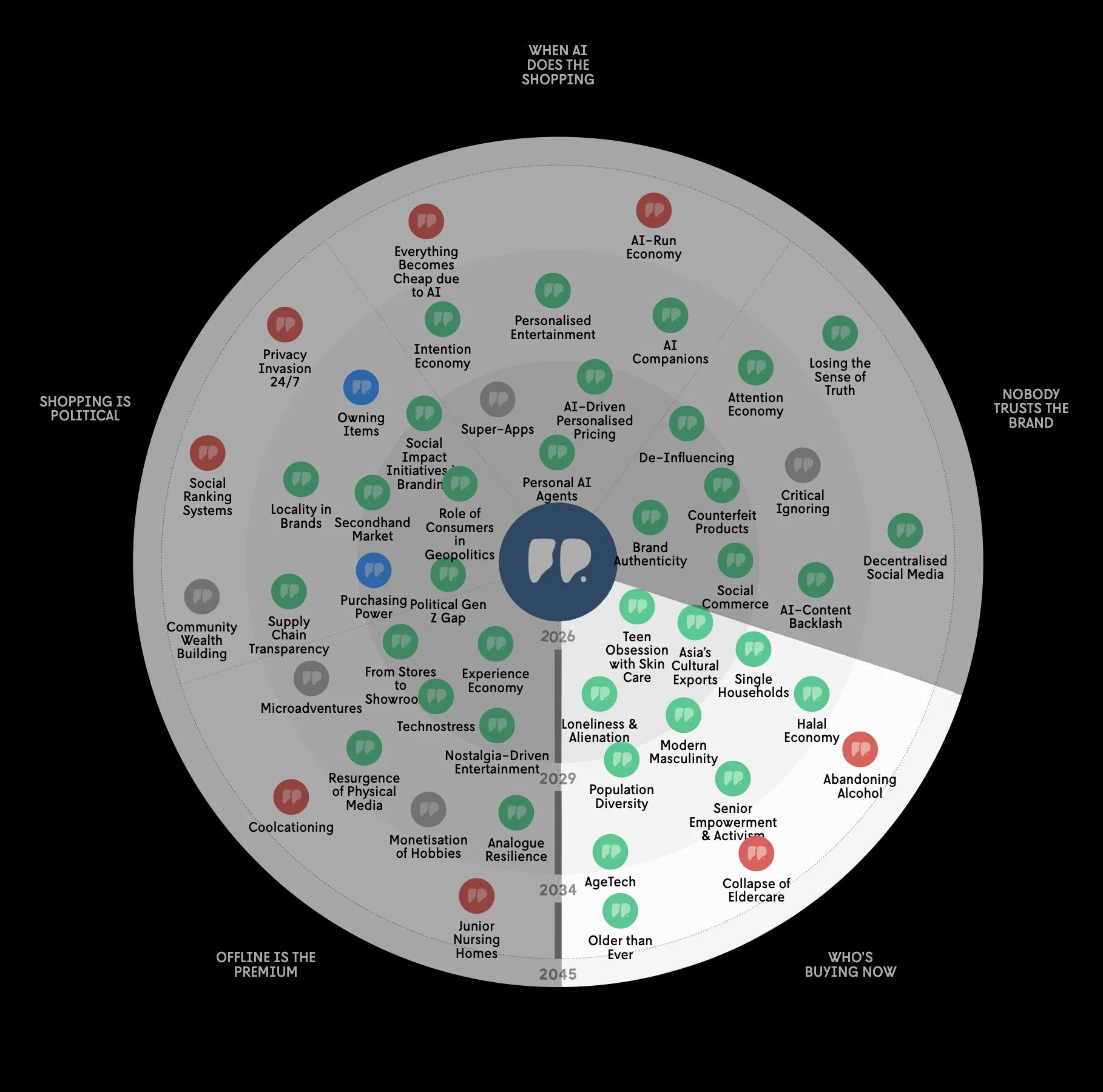
Older than Ever, AgeTech and Senior Empowerment & Activism describe a cohort with time, assets and considerably less patience for being marketed to as a medical condition. Collapse of Eldercare sits next to them, pushing costs that welfare states used to absorb back onto families and private providers, which changes household spending well beyond the people receiving the care.
Single Households rewrites portion sizes, floor plans and travel packages. Population Diversity, the Halal Economy and Asia's Cultural Exports describe consumer groups that were filed under emerging for most of the last decade and have been setting mainstream taste for several years now.
The trends Modern Masculinity, Abandoning Alcohol, Teen Obsession with Skin Care and Loneliness & Alienation describe behaviour inside categories that assumed their demand curves were settled.
The harder part is that these shifts cut across each other rather than sitting in separate segments. Skincare now sells to eleven-year-olds and to seventy-eight-year-olds, two groups that share a category and very little else, and that no segmentation would ever place side by side.
The question: Where is your category already being bought by people it was not designed for?
4. Offline is the premium
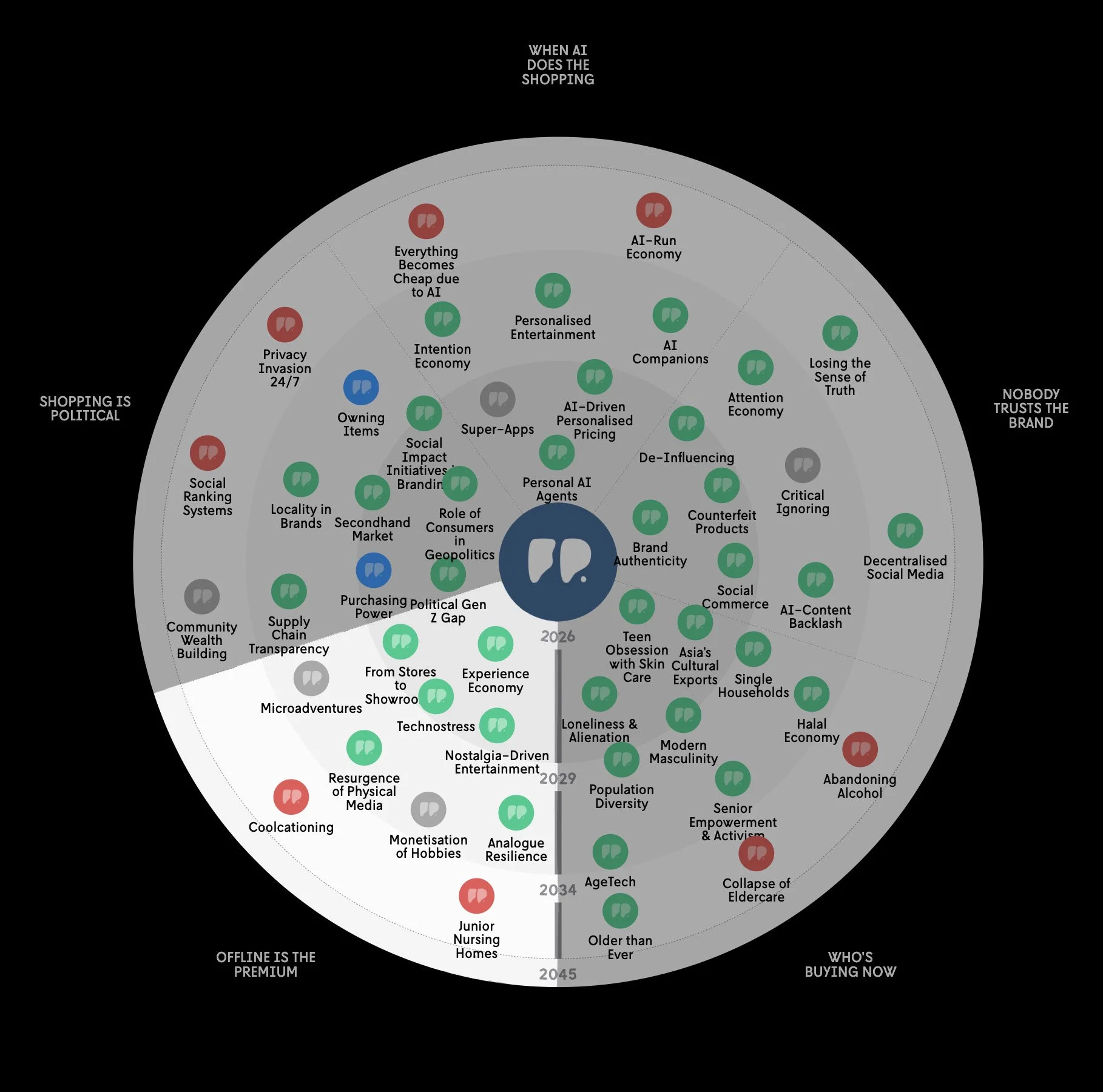
Abundance produces its own scarcity. When content costs almost nothing to make and endlessly less to copy, the things that refuse to duplicate start carrying the margin. A physical object with weight. A room that someone designed to be sat in. An afternoon with no screen in it.
This is easy to dismiss as nostalgia, which undersells it. Trends like The Resurgence of Physical Media and Nostalgia-Driven Entertainment are the visible surface, but the commercial substance sits elsewhere.
From Stores to Showrooms treats retail space as a medium rather than a distribution cost. Experience Economy and Microadventures move spending from objects to hours. Analogue Resilience and Technostress describe a population deliberately engineering friction back into their days. Coolcationing shows the climate altering the holiday calendar, and the Monetisation of Hobbies shows people turning their own time into something they can sell.
The pattern underneath is that scarcity has moved. It used to sit in supply. It now sits in attention, in time, in physical objects and in anything that cannot be reproduced for nothing.
The question: What do you sell that cannot be copied at zero cost?
5. Shopping is political
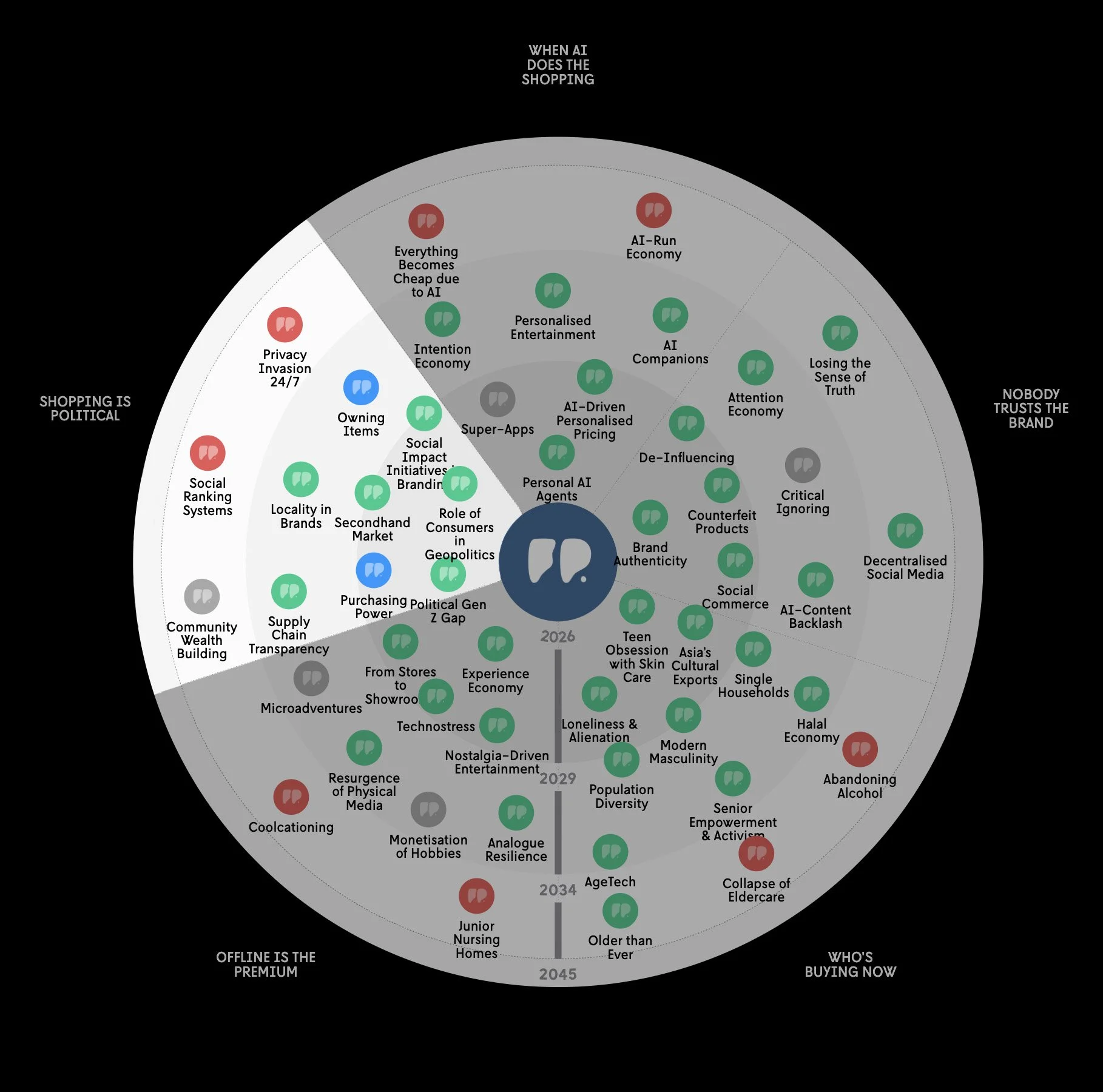
Budgets are tight and politics has reached the shelf. These usually get discussed in separate meetings, though the same person is holding both at the same till. Purchasing Power sets the hard limit on everything else in this theme. Inside that limit, a growing number of buyers are weighing where a product comes from, who profits from it, and what happens to their data.
The Role of Consumers in Geopolitics, Locality in Brands and Supply Chain Transparency describe origin becoming a purchase criterion. Owning Items, a weakening trend, signals that outright ownership matters less to buyers than it used to, while the Secondhand Market grows. Together they describe goods that circulate rather than sit still: rented, resold and passed on. The first sale stops being the end of a product's commercial life, and resale value becomes a commercial question as well as a sustainability one.
The trends Privacy Invasion 24/7 and Social Ranking Systems describe what it costs to be legible to the systems selling to you. Social Impact Initiatives in Branding describes what happens when companies answer, and the Political Gen Z Gap describes a cohort whose politics and purchases are difficult to separate.
Values and budget pull against each other here. Buyers want origin, ownership and data handling accounted for, and they have less to spend than they did five years ago. That rules out the usual answer, which has been to charge a premium for the better-behaved version and leave the rest of the range as it was.
The question: Where in your product, business model, or supply chain are you still assuming customers will not look?
How to use the radar to meet your future customer
The radar runs across three time horizons, from the near term out to 2045. A trend’s position on the radar shows when it is expected to peak, not how much it matters. Something on the outer ring can still reorganise a category the week it lands, and something on the inner ring may already be visible while it is still building momentum. Timing varies by industry too. What is near-term in one category is already ordinary in another.
The more interesting reading is sideways. The pressure that arrives in the mid-2030s probably will not come from any single trend on this radar. It will come from the combination, which is an AI buying layer meeting an older, more sceptical customer with less to spend and more questions about where the product came from. Any of these alone is a project a team could resource and plan around. Arriving together, they describe a different market from the one the current plan assumes.
So treat the radar as a strategic exploration rather than a reading list. Pick the eight phenomena your category cannot ignore, and stress test the current strategy against them, one scenario at a time. What happens to the plan if agents are handling half of repeat purchases by 2031? Then take the other forty-two and ask a different question, which is where you could move first while the rest of the category is still deciding whether any of it is close enough to plan for.
Access the full Consumer of the Future radar
50 trends grouped across five thematic shifts and three time horizons, each with the analysis behind it from our team of futurists: what is driving it, how fast it is moving, and its potential future implications for brands.
Fill in the form below to open the radar.


A foresight radar of 50 consumer trends across five shifts, from AI agents that shop for you to the premium on offline. What it means for brands to 2045.