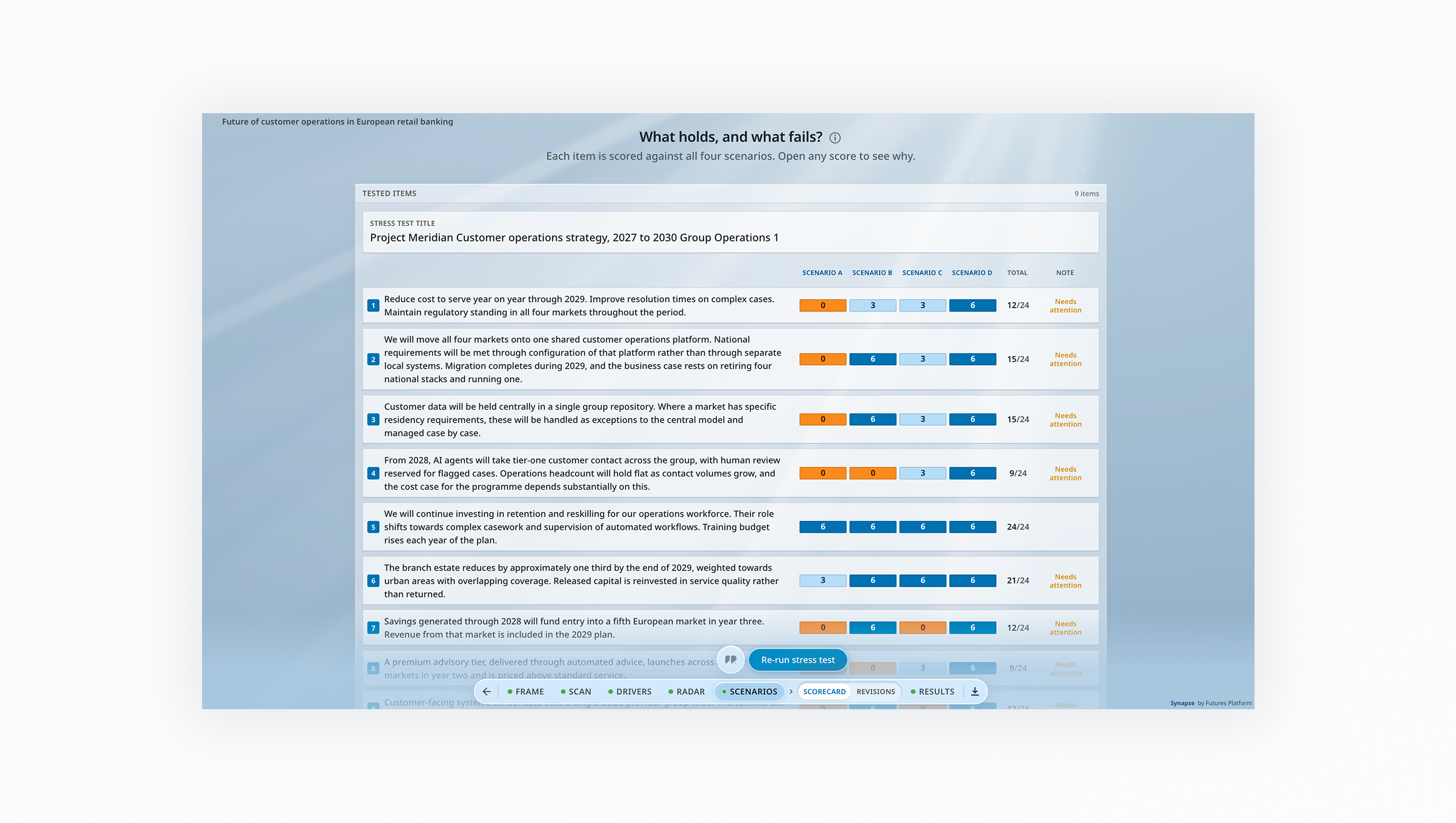
Upload a strategy document, policy draft, investment case, market entry plan or a future vision. Synapse surfaces the key items your plan rests on, scores each one against four different future scenarios, and suggests the revisions that would make them hold across all four.
FUTURE PROOF – BLOG BY FUTURES PLATFORM
A strategy is usually written for a certain vision of the future. The likeliest one, or the most desired one, as seen from the perspective of the team who developed it. That future, or a close version of it, may well arrive. But what happens if it doesn't?
The new strategy stress test in Synapse, Futures Platform's agentic AI workspace for futures intelligence, answers that in minutes. You upload the plan you already have. Synapse reads it and sets out the key items it depends on: the objectives, the assumptions, the bets, the dependencies. All in the plan's own words. Then it scores each item against the scenarios from your exploration. What comes back is a map of your own strategy. Which parts hold across all four futures. Which parts need work. Which have no solid ground underneath them at all.
Decades of facilitation, written into the method
The stress-test and the scoring are based on wind-tunnelling, adapted to AI agents in a workflow designed by Futures Platform's team of futurists. They have spent decades running wind-tunnelling as workshops with enterprises and organisations around the world, and that experience is what shaped the version now inside Synapse: the workflow, the dimensions each item is tested on, and where the line falls between an item that needs attention and one robust enough to survive a given scenario.
Every item, scored against every scenario
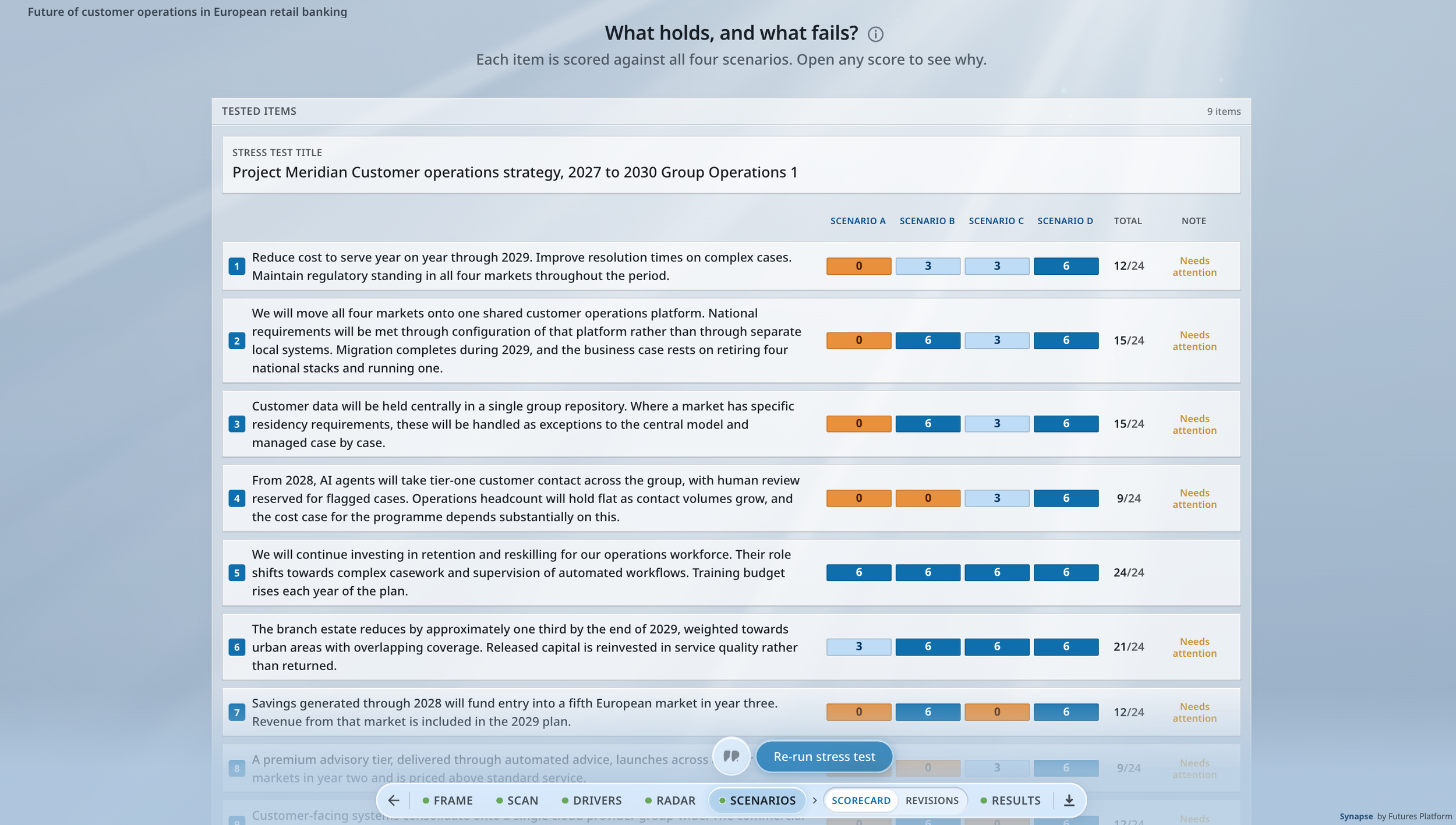
The stress test results presented as a scorecard in Synapse. Every item in the plan, scored against all four scenarios.
The scorecard is a grid. The key items from your plan run down the side. The four scenarios run across the top. Every cell answers one question. Does this particular part of the strategy still work in that future?
A score of six means the item holds in that future. Three means it needs attention. Zero means it fails. The four cells add up to a total out of 24. An item that holds everywhere scores the full 24 and asks nothing of you. Everything below that is flagged as needing attention, and the lowest totals are where to start.
While a row shows you how one item within the plan fares across four different scenarios, the sum of a column shows how the whole plan holds up inside a single future. A high column total means your strategy is likely to hold within that scenario. A column of low scores is a future your plan is largely unprepared for.
Say your plan commits to AI agents taking first-line customer contact from 2028, with people reviewing only the cases that get flagged. Headcount in operations holds flat as volumes grow, and a good share of the cost case rests on that. A reasonable assumption, and a conditional one. In the future where AI capability advances and regulators keep pace, it scores six. In another it gets through with strain, scoring three. In the two futures where regulators slow adoption down, zero and zero. Nine out of 24, flagged as needing attention. The item works in one of the four futures your team mapped, and now you know which one, and why.
Each score opens into the reasoning behind it, and a suggested revision
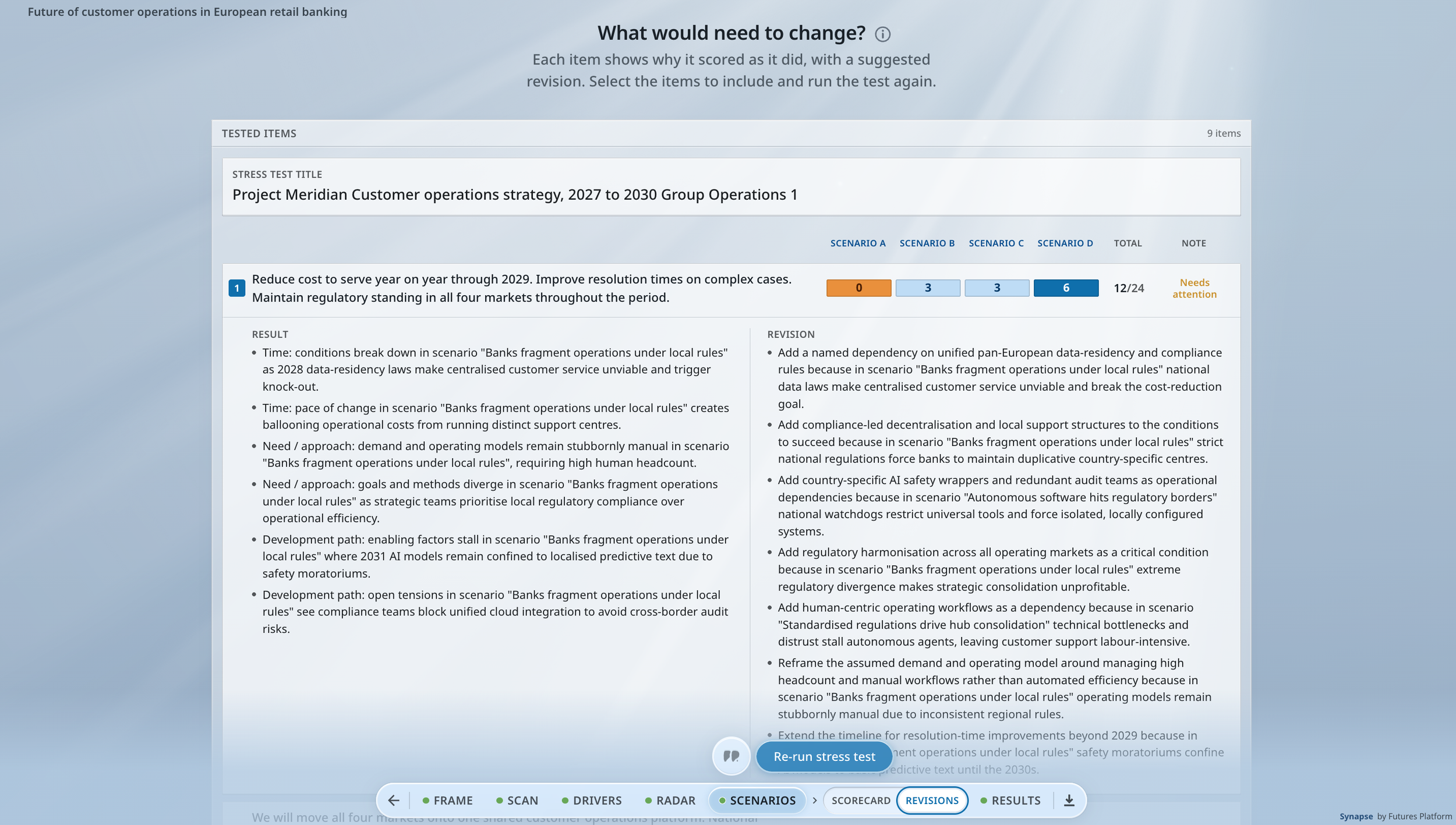
Open any score and the reasoning sits behind it. What gave way, in which scenario, and the revision that would make the item hold.
A score on its own doesn't tell you much, and a verdict is only worth as much as the reasoning behind it. So every score comes with both. Why it landed where it did, and what to do about it.
Open any row, and the result explains what gave way and where, whether that is geography, timing, the development path, or a knock-out that takes the entire item down rather than denting it. Next to it sits the revision, written as a change you could make to the document itself.
The last word stays with you. Synapse marks the weak points and proposes the edit. Accepting it, softening it or throwing it out is a judgement your team makes.
From multiple future scenarios to what they mean for your plan
Building different future scenarios is one piece of work. Working out what each of them means for the plan on your desk is another, and that second step is where teams tend to lose time. The stress test does the translation against your own document. Every line of reasoning names the scenario it came from and the part of your plan it touches, so what you are reading is your strategy under those conditions rather than general commentary about the future.
Your team opens the review with the implications already set out, item by item, which lets your strategy session focus on the important questions: weighing the trade-offs, judging which revisions are worth making, deciding what the organisation is prepared to commit to. Run the test again whenever the plan moves and the groundwork moves with it.
“Scenarios become useful the moment a team can see what they mean for the decision in front of them. Reaching that point takes interpretation, and it is work that often eats the first half of a strategy session. Having it ready at the start changes where the conversation begins.”
Availability
The strategy stress test is available to Synapse users. Anything you can upload can be tested: an operating plan, an investment case, a market entry proposal, a policy draft. Scorecards and revisions export alongside the decision-ready report.
More at futuresplatform.com/synapse.
About Synapse
Synapse is a futures intelligence workspace by Futures Platform. It guides foresight, strategy, market intelligence and risk teams through a structured sensemaking flow, from a brief to a decision-ready report, using specialised AI agents that execute a methodology designed by professional futurists. It works on expert-curated foresight analyses and verified market intelligence rather than open web content.
See Synapse’s stress test applied to a strategic question your team is working on right now.
Fill in the form to book a guided demo below, and our team will get back to you.