
The spark between insight and action: The design philosophy behind Synapse
We sit down with Mika Ilari Koskinen, the lead designer behind Synapse, Futures Platform’s new agentic AI workspace for Futures Intelligence, to talk design philosophy: the choices that shaped the product, and why good design helps people cope with uncertainty. First in a series taking you behind the scenes of building Synapse.
FUTURE PROOF – BLOG BY FUTURES PLATFORM
Mika Ilari has just finished moving into a new office. The labels are up, the boxes are gone, and after a couple of restless days, he tells us, there is no chaos anymore. Everything is in its place. It is a fitting setting for a conversation about Synapse, because order out of noise turns out to be the idea sitting underneath the entire product.
Synapse is a Futures Intelligence workspace, built to close the gap between analysing future change and acting on it. Most organisations are awash in signals, trend reports, and analyses. Clarity, the thing they actually need when a decision lands, is the part that goes missing. We talk to Mika Ilari to understand how that problem became a product, and how design turned out to be the answer at almost every turn.
Why the name Synapse?
The first thing to know about Synapse is that the name is a design decision in its own right. It comes from biology, from the junction where one nerve cell passes a signal to the next.
”We kept coming back to the nervous system,” Mika Ilari says. ”A signal has to travel from where it begins to where it matters, with as little friction as possible. When a nerve cell sends a signal to the next one, that is the synapse. That is the gap we wanted to close, between an early insight and a future-fit decision.”
Reaching past the usual technology vocabulary was a deliberate decision. AI is opening genuinely new ways of working, and the old language does not always fit them.
”It was inspiring to get away from the very traditional ways of talking about these things. We are facing a new kind of reality with AI, and we should think about how to go beyond our own expectations. A synapse is a metaphor for the ‘aha’ moment, when everything clicks and the spark flashes.”
Design as a core asset, not a coat of paint
Good design starts with the people who will use the product. Synapse began with a close study of who they are, and the work surfaced two distinct profiles.
The first is the analyst, the one identifying early signals of change, analysing future trends, and exploring multiple future scenarios. They gather information from scattered places, hold complex pictures in their head, and turn it all into something coherent. It is genuinely hard work, and most tools make it harder by crowding everything onto the screen at once.
The second is the decision-maker. The CEO, or the head of strategy, risk, or intelligence, who receives the results and has to act on them, often with very little time and a great deal at stake. They need conclusions they can trust, framed clearly to move on.
”The analyst really struggles with complex information coming from many places at once, and has to put it all together,” Mika Ilari notes. ”It is challenging work to do properly.”
Synapse is designed for both perspectives at once, with different means for each. For the analyst, that means a total-focus environment. The top navigation disappears. The interface strips back to the minimum, so the only thing in front of you is the work itself. For the decision-maker, the same principle plays out at the other end, where the analysis resolves into something clear enough to act on at a glance.
”If it adds noise, take it out”
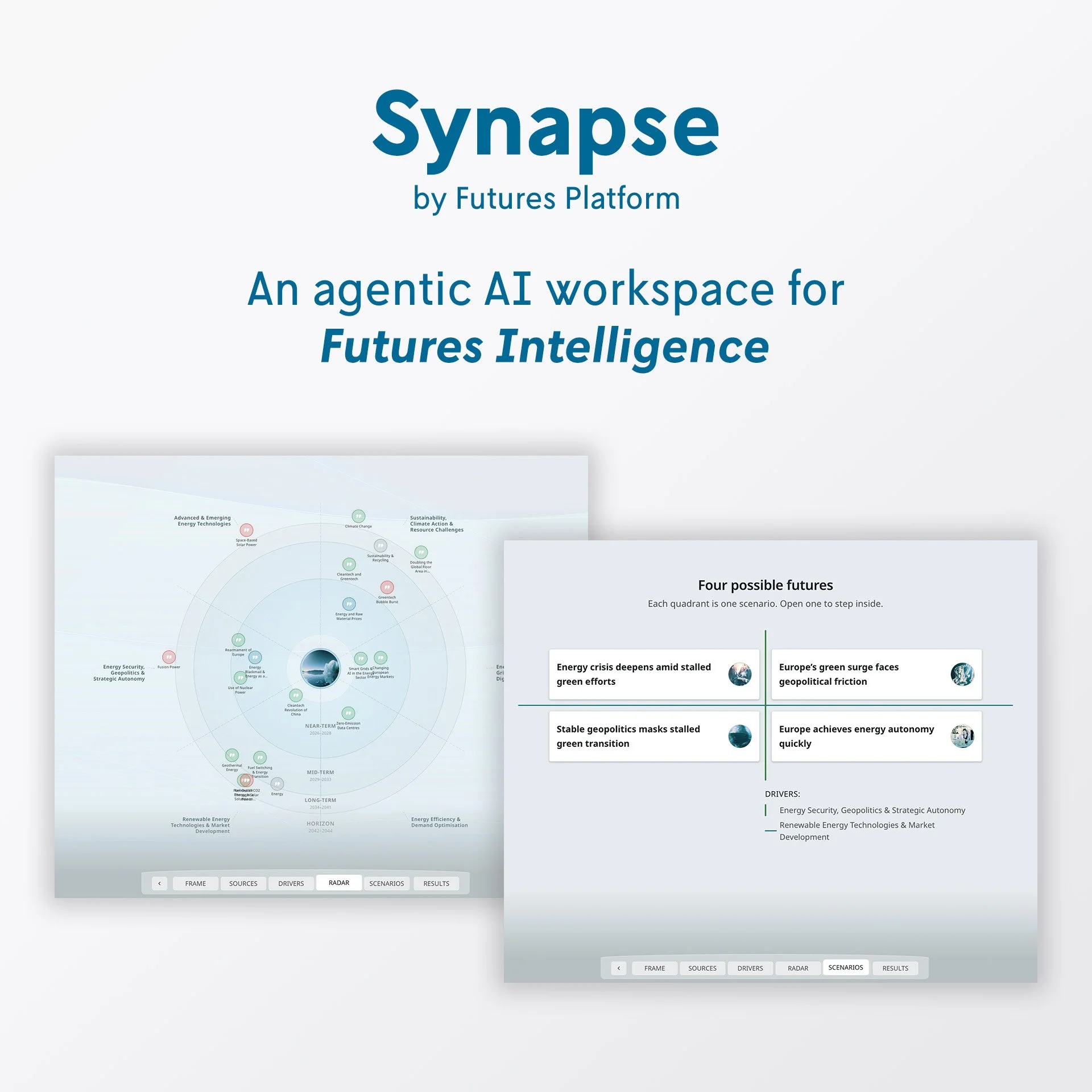
At the centre of the product sits the sense-making flow, where a project moves from a brief, through framing the right questions, to surfacing the insights that matter, mapping them across themes and time horizons, opening up scenarios, and arriving at a decision-ready report.
”Reducing noise is one very good design tool to provide clarity,” says Mika Ilari.
This is why the sense-making flow strips everything non-essential out of the viewport. When you work inside it, you see only what the current step needs. Everything else steps aside. Mika Ilari calls this one of the real innovations of the product: the interface cleared of clutter precisely when concentration matters most. It sounds simple. It is one of the harder things to build well, and one of the easiest to feel when it is right.
There is a wider conviction underneath the craft. The world is turbulent, change is fast, and uncertainty is the baseline now rather than the exception. ”We believe good design really helps people cope with this uncertainty,” he says. ”That is why we do it properly.” Clarity, in that light, stops being decoration. It becomes a form of support.
Designing for trust
Synapse informs decisions that can shape the future of an entire organisation. That raises the stakes for trust, and trust itself is a design problem.
Part of it is clarity and transparency in the work. Part of it is restraint with AI. Mika Ilari says the team thinks carefully about where AI genuinely helps, and where it does not belong.
”We really think carefully about where to use AI. And if we decide to use it for something, we really care how we do it, because trust is so important for our customers, especially today, when a model can invent a source, a statistic, or a whole trend, and present it with complete confidence.”
That care extends beneath the interface, to what the product works on. Synapse draws on expert-curated foresight and market intelligence rather than the open internet, which keeps hallucinated or unverifiable content out of the process from the start. Human experts design the logic, the methods, and the sources. Purpose-built AI agents then execute that expert-designed process across trusted material, step by step. The work is human-led and AI-assisted, which is the reverse of how most AI tools behave.
Trust also shapes how you work with Synapse day-to-day. It is built for conversation — you interact with it continuously, the way you would with any capable AI tool, and it grows sharper and more attuned to your needs over time. That conversational quality is itself a design stance: a product you can question, redirect, and refine as you go is a product you can trust to stay close to your thinking.
The decision to build an entirely new product from scratch
One of the more revealing parts of our conversation is about a decision the team almost made differently. The first instinct was to keep adding AI on top of Futures Platform’s existing foresight platform, where we have used AI since 2018.
”It soon turned out that would just be facelifting here and there,” Mika Ilari admits. “The way people now expect to use these tools made a legacy rebuild impossible. So we committed to a new product, and built an AI-native Futures Intelligence workspace from the ground up.”
He is careful, though, not to let the AI-native story run away with itself. Synapse is not AI all the way down.
”We are not blindly going AI-native and letting that dominate the product narrative. We are not fully legacy, and we are not fully AI. We are something hybrid in between, and this is the best way to go.”
By hybrid, he means that Futures Platform’s proprietary, expert-curated content and proven in-house foresight methods came along into the new build, because those are the assets that make the AI worth trusting. The goal was always to solve customer problems with the best of what trusted expert insights, foresight methodologies and AI can each offer.
The discipline of killing your darlings
A product like Synapse generates a flood of exciting ideas. For a designer, the harder craft is choosing between them.
Mika Ilari describes a deliberately demanding question the team kept returning to. Rather than simply solving each brief, they asked what the best possible solution would be in the age of AI. The answer, more often than not, was not the one he would have reached for alone.
”Quite often it is not the one I, as a designer, would have chosen,” he says. ”When you have more people around, customers, the teams, the foresight community, you multiply the value of the solutions.” In many cases the team killed their own darlings — the ideas they had walked in with — and went with something more worthy instead.
Where the design is heading
We end on the future. ”We used to think we were doing this service for human beings,” Mika Ilari says. ”But the user is not only a human being anymore. It is a human being plus their AI agent.” Increasingly, the agent may be the one reaching into the workspace on a person’s behalf. Designing for that shift is part of what makes this work interesting right now.
For all the talk of agents and AI, the conviction underneath stays human and stays simple. The future is uncertain and continuously in flux, but the right signal, reaching the right decision at the right moment, is what lets organisations stay future-ready. Everything in the design of Synapse bends toward that.
This article is the first in a series. In the pieces ahead, we go deeper into the foresight methodology behind Synapse’s sense-making flow, the agentic AI doing the work underneath, and a question the team is increasingly sitting with: what design looks like when the user is no longer only a human, but a human and their AI agent.
What does future change mean for your organisation?
That's the question most futures tools leave unanswered. Synapse is a Futures Intelligence workspace built specifically to answer it, guiding you from fragmented signals to decision-ready deliverables.
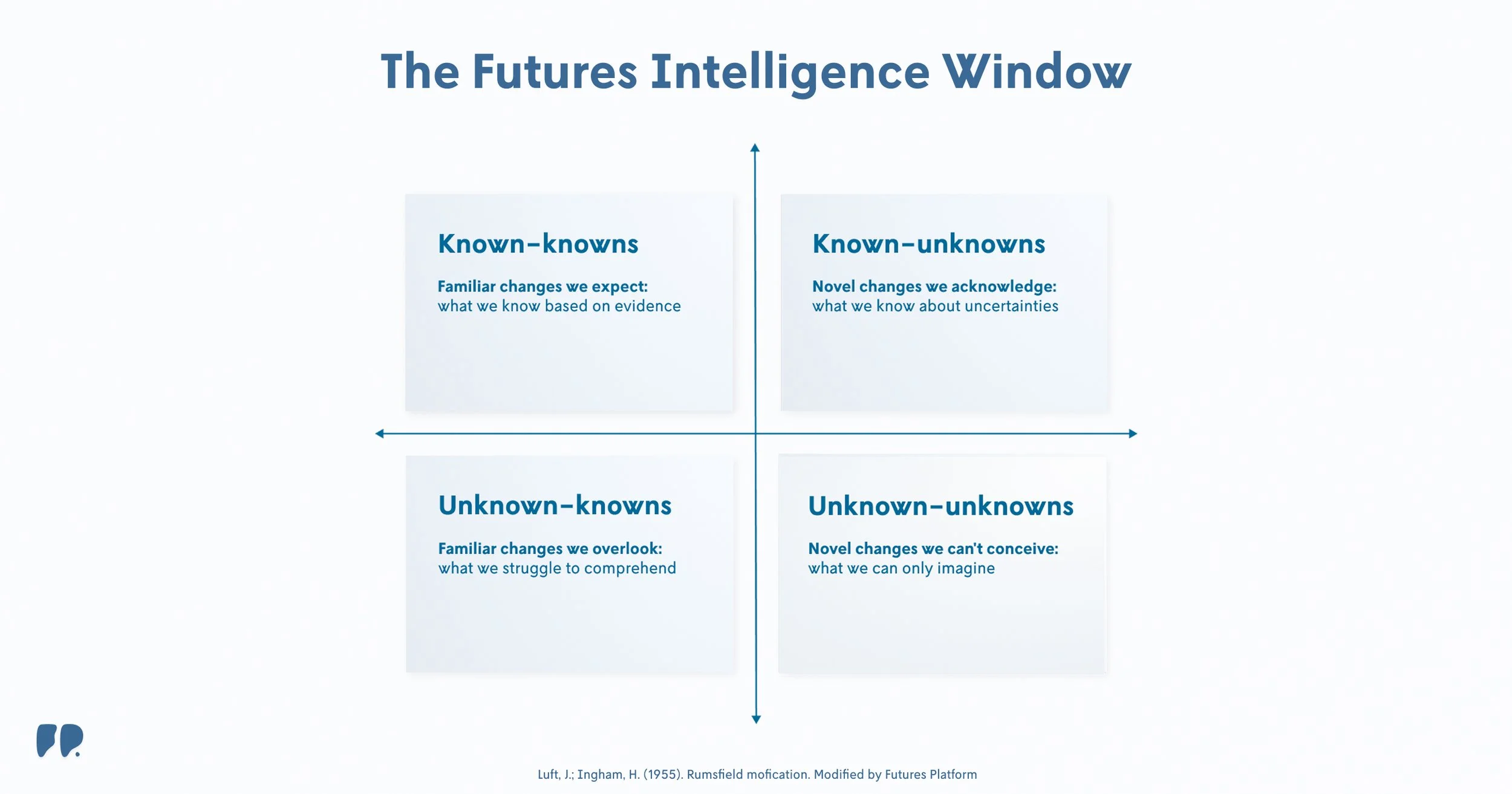

Futures Intelligence is an integrative capability that brings different forms of future-related insights in one connected sense-making flow to turn them into shared, decision-ready understanding. It brings together different types of future-focused knowledge. Used in isolation, each has blind spots. Used together, they build a comprehensive picture of the possible futures ahead.