
What is Futures Intelligence? A Complete Guide
Futures Intelligence is an integrative capability that brings different forms of future-related insights in one connected sense-making flow to turn them into shared, decision-ready understanding. It brings together different types of future-focused knowledge. Used in isolation, each has blind spots. Used together, they build a comprehensive picture of the possible futures ahead.
FUTURE PROOF – BLOG BY FUTURES PLATFORM
Futures Intelligence is an integrative strategic capability that connects future-related insight from across an organisation — foresight, market intelligence, strategy, risk, innovation — and makes it usable at the point where decisions are formed.
It is not a replacement for existing disciplines. It is the structured sense-making layer that sits between insight production and strategic decision use: the capability that takes what different teams already know about the future and answers the question those individual disciplines cannot answer alone:
What do these insights mean together, for us, right now?
Ready to close the gap between insight and decision?
This article draws from our Futures Intelligence whitepaper, which explores how organisations can close the gap between insight and genuinely future-fit decisions. Download it here:
Why Futures Intelligence is needed now
Over the past decade, organisations have significantly expanded their capacity to understand the future. Foresight teams explore long-term scenarios. Market intelligence tracks competitive dynamics. Risk functions assess structural exposure. Innovation teams scan emerging opportunities.
Despite this, clarity often remains elusive when strategic decisions need to be made. Not because the analysis is weak, but because a structural gap exists between insight production and decision use.
Three forces create this gap:
1. Fragmentation. Future-related insight is generated across multiple functions, each with its own mandate and time horizon. Without a shared process for integration, perspectives accumulate side by side rather than converging into a shared understanding. The result is parallel interpretations: different teams draw different conclusions from similar signals, and alignment depends on informal coordination rather than a consistent way of working.
2. Noise. Future-relevant information now arrives from many directions simultaneously. Not all inputs carry the same relevance, maturity, or reliability. Without a shared framework for prioritisation, volume outpaces interpretation. The question shifts from "what information do we have?" to "which developments deserve our attention, and why?" — and that second question often goes unanswered.
3. Trust and implicit judgment. As insight volumes grow and sources multiply, judgment about what to rely on is shaped by institutional authority or familiarity rather than shared criteria. Valuable insights may be underweighted; others gain influence by default. When this happens implicitly, organisations cannot learn from the disagreement.
Futures Intelligence addresses this structural gap by formalising sense-making as a shared, structured, and continuous strategic capability.
How Futures Intelligence relates to existing disciplines
Futures Intelligence sits across disciplines rather than within any one of them. Futures Intelligence does not compete with or absorb these disciplines. It gives structure to the work that already happens — often informally and unevenly — by connecting their outputs, surfacing contextual implications, and making their insights usable at the point where decisions take shape.
| Discipline | Core question | Contribution to Futures Intelligence |
|---|---|---|
| Strategic foresight | How might the future diverge from today? | Expands the horizon; explores scenarios and discontinuities |
| Market & competitive intelligence | What is happening in our market now? | Grounds decisions in current conditions and near-term signals |
| Strategy | What direction should we take? | Connects insight to ambition, priorities, and resource allocation |
| Risk management | Where are we exposed? | Identifies vulnerabilities and builds preparedness |
| Innovation management | What opportunities are emerging? | Translates change into new offerings and ways of working |
| Futures Intelligence | What do these insights mean together, for us, right now? | Integrates outputs across disciplines; supports shared sense-making at the decision table |
The Futures Intelligence cycle

Futures Intelligence operates through a five-phase cycle:
Frame — Define the strategic question and the organisational context it sits in. Establish which time horizons matter, who the key stakeholders are, which uncertainties are material, and where the organisation is prepared to take risk. Framing is the step most often underestimated — and the one that determines the quality of everything that follows.
Scan — Explore the external environment for future-relevant insights: trends, weak signals, emerging issues, scenarios, structural shifts. Draw on the full intelligence landscape, across functions and time horizons.
Analyse — Examine patterns in what has been surfaced. Assess implications. Evaluate significance relative to the framed question. Distinguish what demands action from what warrants monitoring and what can be parked.
Synthesise — Bring insights together across time horizons, disciplines, and perspectives into a coherent, integrated view. This is the sense-making layer — the moment where separate streams are connected and shared understanding is built.
Decide — Translate synthesised intelligence into decision-ready recommendations. Structured, traceable to their sources, grounded in organisational context, and designed for direct use by the people who need to act on them.
The four types of Futures Intelligence
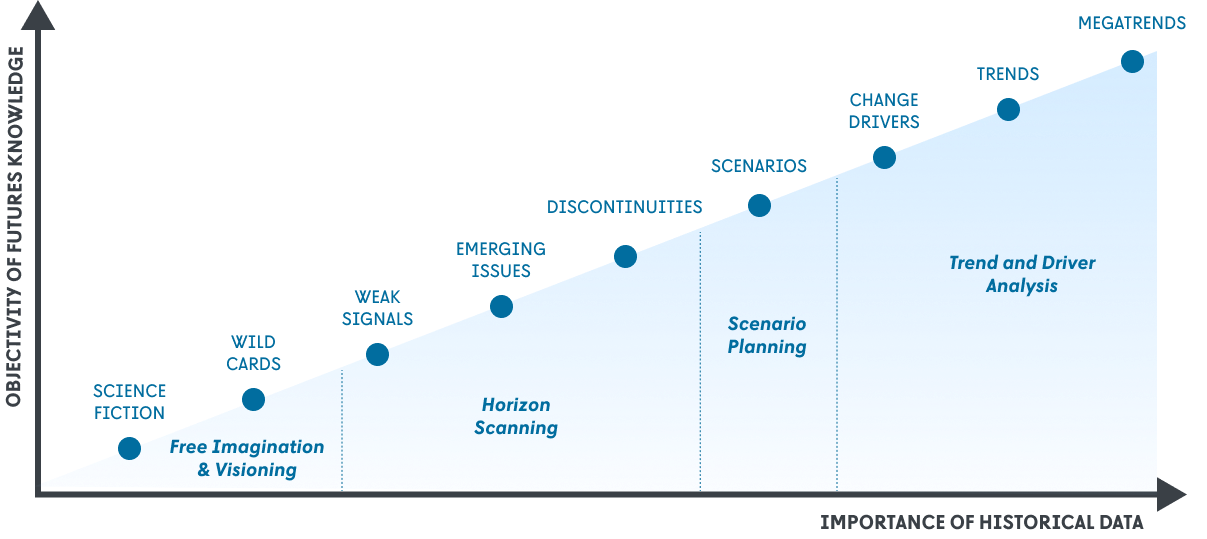
Futures Intelligence can be built using four distinct methods, each suited to a different type of future knowledge. These methods differ in how strongly they draw on historical data and measurable evidence, and in how objective their results aim to be.
1. Trend and Driver Analysis
Trend Analysis works with visible and measurable change. Megatrends describe large-scale, long-duration shifts: demographic ageing, climate transition, geopolitical power shifts. Their direction is relatively stable; their value lies in constraint-setting rather than prediction. Trends sit closer to current conditions — faster-moving, more volatile, and more directly connected to near-term decisions.
A key discipline within Trend Analysis is recognising trend maturity: early signals require monitoring; accelerating trends demand positioning; mature trends often call for optimisation. Not all trends demand immediate response.
2. Scenario Planning
Scenario Planning addresses the uncertainties organisations can name but cannot resolve. In Futures Intelligence, scenarios are not forecasts or stories. They are structured environments for examining how different forces might interact — and what those interactions mean for choices being made today.
The value of scenarios lies less in their narratives and more in the shared understanding they create: making implicit assumptions visible, aligning perspectives across teams, and providing a common reference point for strategic discussion.
3. Horizon Scanning
Horizon Scanning addresses developments already present in the environment that remain under-recognised or misinterpreted. It works with discontinuities (breaks in patterns of development), emerging issues (developments beginning to take shape without historical precedent), and weak signals (the faintest early expressions of change, treated as hypotheses rather than evidence).
The core discipline here is vigilance: noticing patterns across contexts, tracking whether signals are gaining momentum or fading, and distinguishing meaningful change from noise before the distinction becomes obvious to everyone.
4. Free Imagination and Visioning
Free Imagination and Visioning works in the territory that conventional analysis cannot reach. Wild cards describe low-probability, high-impact events that stress-test existing assumptions — not to justify alarmist planning, but to surface hidden dependencies and fragilities. Science fiction provides a structured way to explore how emerging technologies and social shifts might interact in lived, human contexts, surfacing ethical dimensions and behavioural implications alongside technical possibilities.
The full Futures Intelligence whitepaper sets out the complete framework — how these four methods work together, what gets lost when organisations rely on only one, and how to build a futures practice that actually informs decisions.
Get your free copy
The defining characteristics of Futures Intelligence
Decision-focused. Futures Intelligence asks what kind of understanding is needed to support a specific future-focused decision — not what is generically interesting or analytically rich. Analysis is shaped by the need for direction, prioritisation, and trade-offs.
Executive-ready. Its outputs are designed for direct use by leadership teams: synthesised into forms that can be discussed, challenged, and acted upon by people with limited time and competing priorities.
Grounded in trusted futures knowledge. Futures Intelligence is deliberate about what enters the sense-making process. Starting from credible, curated insight reduces noise and builds confidence in conclusions.
Contextual. The same trend can represent opportunity for one organisation and a risk for another. Futures Intelligence embeds organisational context throughout — avoiding generic conclusions and producing direction that reflects specific ambitions and constraints.
Synthesised. It connects what is normally kept separate: short-term market movements, long-term structural shifts, emerging signals, and explored scenarios — brought together in one structured sense-making flow.
Continuous. Rather than treating futures thinking as episodic, Futures Intelligence supports ongoing interpretation as conditions evolve — reducing the cost of re-orientation and helping organisations maintain direction without rigidity.
Who benefits from Futures Intelligence
Futures Intelligence does not sit inside a single function. Its value comes from its ability to move across organisational boundaries and connect perspectives that are usually held apart.
Foresight and futures teams gain a clearer pathway from exploratory work to strategic impact
Market and competitive intelligence teams gain a broader frame for signal prioritisation and a structured connection to longer-horizon shifts
Strategy teams gain a structured interpretive layer that improves the quality of strategic debate and makes decision reasoning more defensible
Innovation teams gain the ability to distinguish novelty from relevance by situating ideas within longer arcs of change
Risk teams gain a broader view of structural uncertainty that extends beyond static risk registers
Leadership and executive teams gain reduced noise, clarified trade-offs, and decision reasoning that is easier to articulate and defend over time
How to get started with Futures Intelligence
Futures Intelligence does not require a new department, a transformation programme, or an overhaul of existing processes. In most organisations, the raw materials are already present.
Seven practical starting points:
Begin with a real decision — choose one strategic question the organisation is currently facing and apply structured sense-making to the insights already available
Slow the interpretation — introduce a deliberate pause between insight and conclusion, explicitly asking what assumptions are embedded and how different insights interact
Frame before debating options — agree on time horizons, key uncertainties, constraints, and risk appetite before evaluating choices
Use fewer insights, more deliberately — distinguish what demands action, what warrants monitoring, and what can be parked
Clarify how different teams contribute — keep disciplines distinct and complementary rather than collapsing them into one
Make stress-testing a routine — regularly wind-tunnel strategies and investments against different future conditions
Integrate in existing processes — introduce Futures Intelligence into strategy reviews, investment discussions, and leadership meetings rather than creating a separate activity
What does future change mean for your organisation?
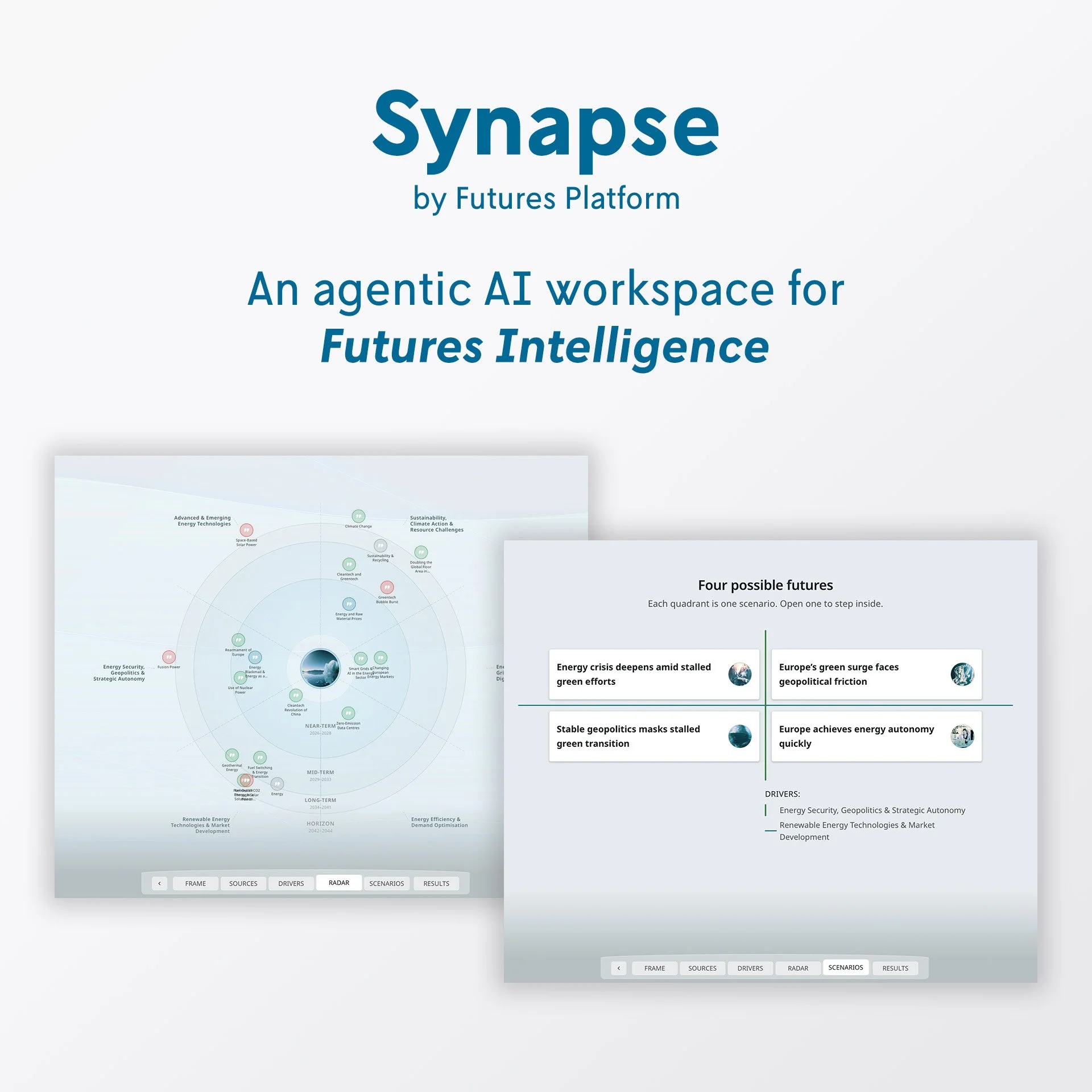
That's the question most futures tools leave unanswered. Synapse is a Futures Intelligence workspace built specifically to answer it, guiding you from fragmented signals to decision-ready deliverables.
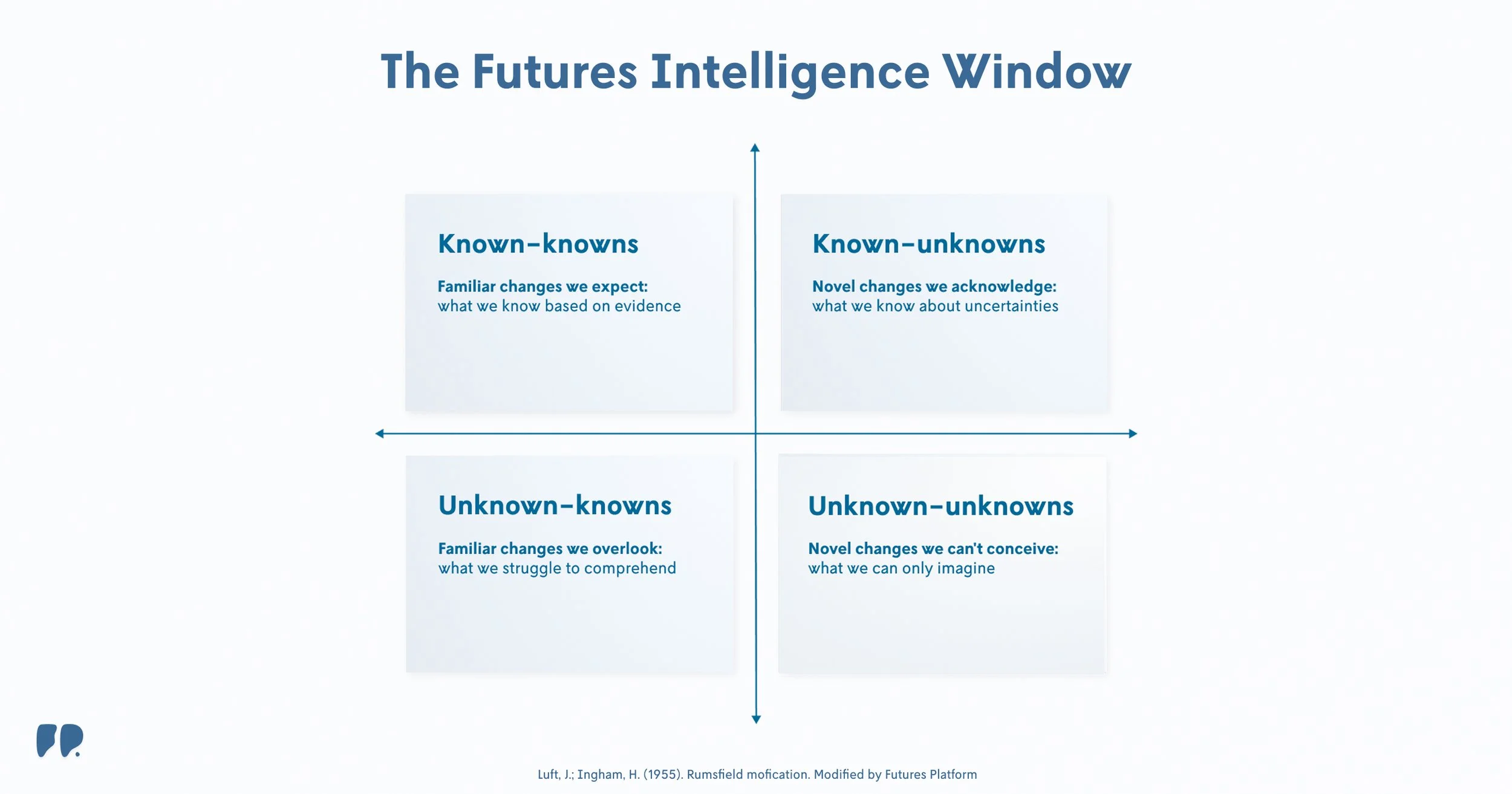

Futures Intelligence is an integrative capability that brings different forms of future-related insights in one connected sense-making flow to turn them into shared, decision-ready understanding. It brings together different types of future-focused knowledge. Used in isolation, each has blind spots. Used together, they build a comprehensive picture of the possible futures ahead.