
"An autonomous vehicle for foresight": The methodology behind Synapse
We sit down with Max Stucki and Marianna Mäki-Teeri, the futurists who built the sense-making flow behind Synapse, Futures Platform's agentic AI workspace for Futures Intelligence. The conversation covers the foresight method running underneath, why the sources are deliberately limited to a closed, expert-curated pool, and how to bring AI into the work without letting it decide the future.
FUTURE PROOF – BLOG BY FUTURES PLATFORM
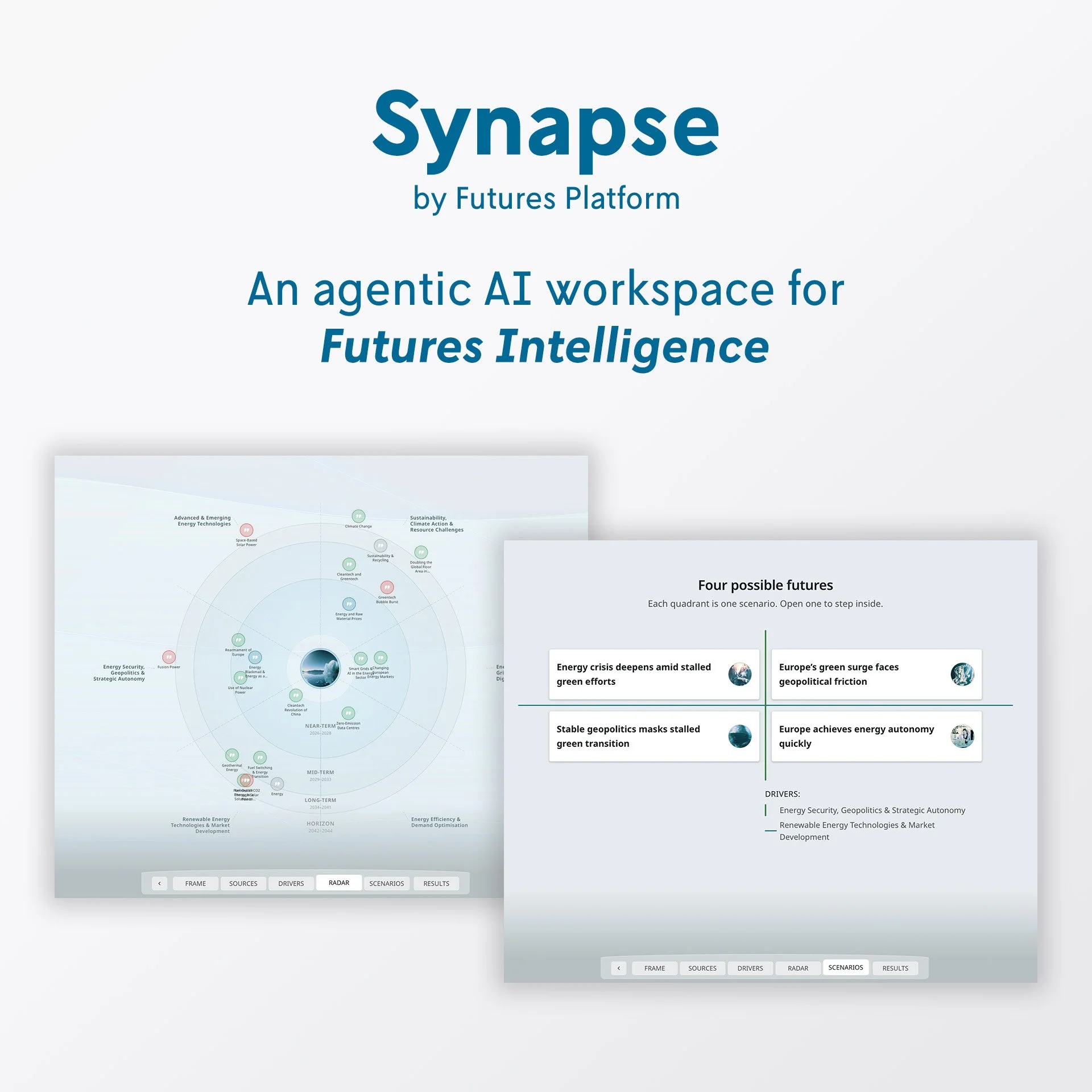
In the first article in our behind-the-scenes series, we looked at the design philosophy behind Synapse. In this one, we go deeper into Synapse's six-step sense-making layer, where multiple AI agents work to frame a future exploration, scan the horizon, surface key drivers of change, identify future phenomena, build scenarios, and finish with a decision-ready report.
Underneath this sits decades of foresight practice, translated step by step into something agents can run. We sat down with the two futurists who did that translating to understand how it works, and where they drew the line between what the machine does and what stays with the human.
“An autonomous vehicle for foresight”
Start with how a futurist actually thinks, because that is where Synapse starts too.
"Every foresight project begins with clear specifications," Max Stucki explains. "The topic, the angle, the time frame, the question you are really asking. Synapse follows that very strictly."
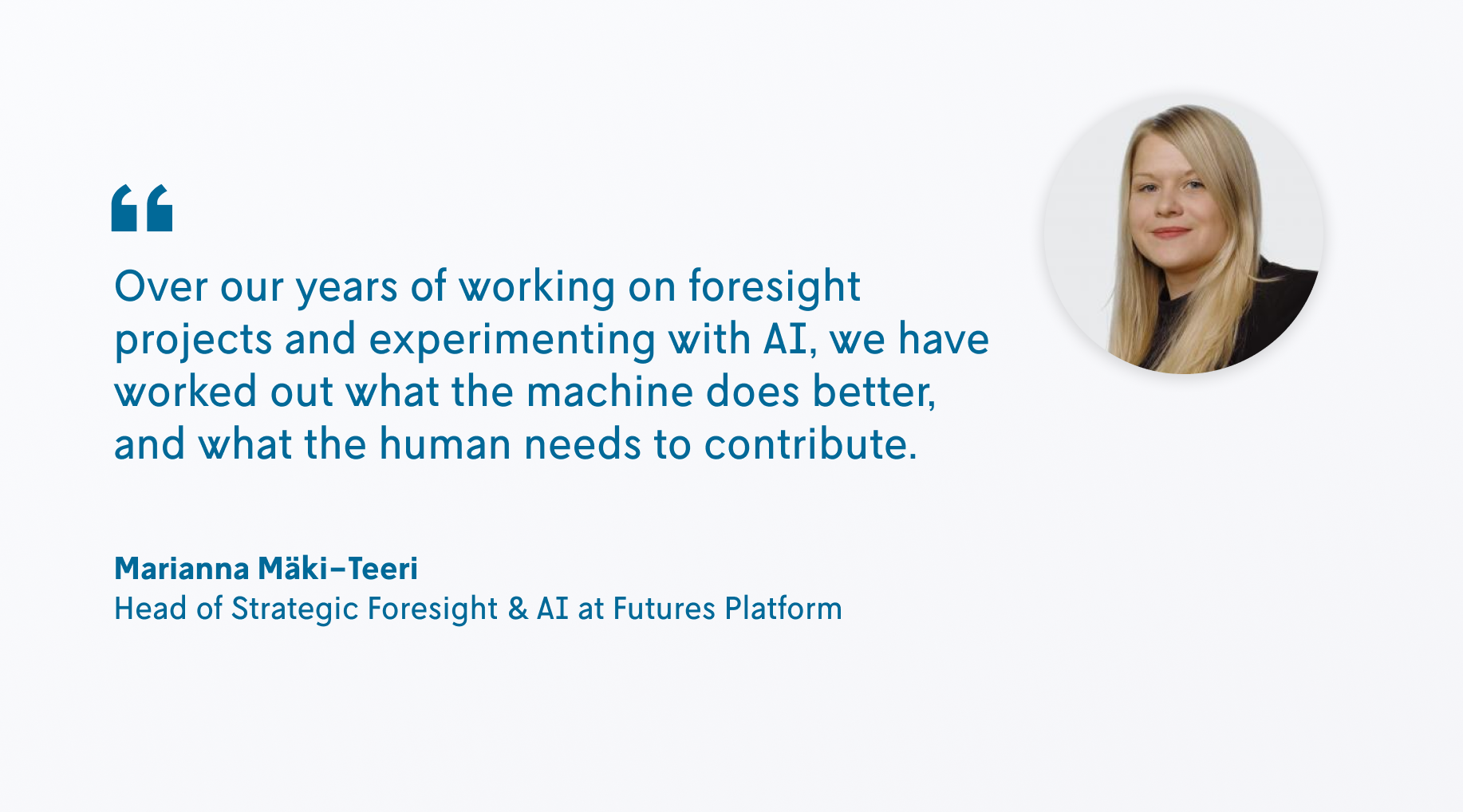
Marianna Mäki-Teeri has a memorable way of putting it: "I call it an autonomous vehicle for foresight. Over our years of working on foresight projects, and experimenting with AI, we have worked out what the machine does better, and what the human needs to contribute."
In Synapse, the human holds the high-value role: setting the context, the need, and the aim. "That is something the AI cannot do itself," she says. The steps in between are built on established best practices and academic methodologies in the field, on the work of pioneers who shaped it, and on the Futures Platform team's own years of hands-on work. They trained the agents to work the way they would work themselves.
Increasingly, questions about the future now reach far more people than they used to, well beyond any dedicated foresight team. Most of the people who need to answer those questions are not trained futurists, and they shouldn’t have to be. Synapse carries the method, the distilled work of people who did spend those years, and makes that rigour available to anyone who needs it. "With Synapse, you don't need to be a futurist to follow a structured, methodologically sound foresight process," Marianna says.
Inside the sense-making flow
The sense-making flow encodes methods that any foresight professional would recognise. Horizon scanning, to understand what is emerging. Drivers of change, to find the forces shaping the question at hand. Future phenomena mapped across a landscape, so patterns become visible. Critical uncertainties, to locate what matters most and is hardest to predict. And the two-by-two scenario matrix, which opens up a set of plausible futures based on two critical uncertainties.
This is the point Max emphasises when he sets Synapse apart from a general-purpose model. "If you ask a generic model to give you a foresight process, it is a black box. You have no way to verify it, especially if you don't know the process yourself."
Foresight has these methods for a reason. The future is open, and it is easy to get lost in it, or to wander so far that you lose sight of the strategy you came in with. Structured methods keep the work focused and genuinely exploratory at the same time. They also push against something more stubborn. Left to our own devices, we as humans tend to think about the future in predictable ways. We assume it will look much like the present. We extrapolate in straight lines, anchor on whatever happened most recently, and settle on a single scenario we feel is most likely. Foresight methods are built to interrupt those habits, and to hold open the alternatives our instincts tend to close down.
That is why the methodology matters. "You can think of Synapse as a futurist holding your hand, making sure you are going in the right direction," Marianna says.
Why Synapse only draws on expert-curated sources
When Synapse scans the horizon, it doesn't search the open web. It reads a curated body of market insights and future phenomena, and nothing outside it.
While it may sound like a limitation, this restriction is actually there to broaden the horizon:
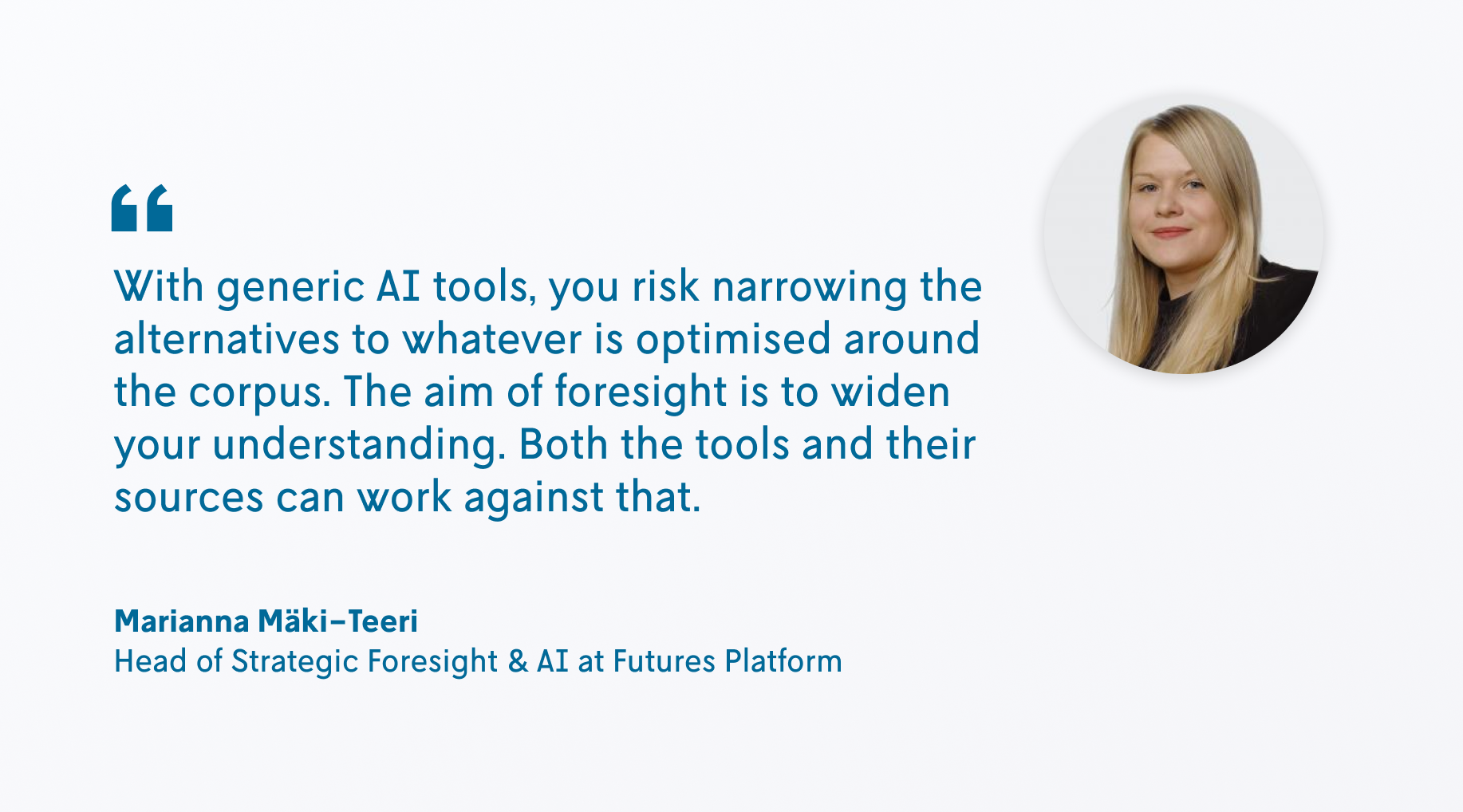
"With generic AI tools, you risk narrowing the alternatives to whatever is optimised around the corpus," Marianna says. "The whole aim of foresight is to widen your understanding of what could happen. Both the tools and their sources can work against that."
Closing the sources does two things at once. It keeps ungrounded material out of the process, and it sharpens the focus of the futures being explored by anchoring them in curated forward-looking content.
The curated body of content behind Synapse is a living library, kept current by Futures Platform's in-house team of futurists: analyses of trends, change signals, and wild cards. Alongside it sits market intelligence drawn from trusted research providers and curated by the same expert eye. Every source has been hand-picked and chosen because it looks forward.
It also gives teams access to something they could not easily assemble on their own. "If a team tried to build that much intelligence themselves," Marianna notes, "it would take years."
Keeping the human in control
Speed is the obvious thing to say about any AI tool. It is not the thing Max or Marianna lead with when they talk about Synapse.
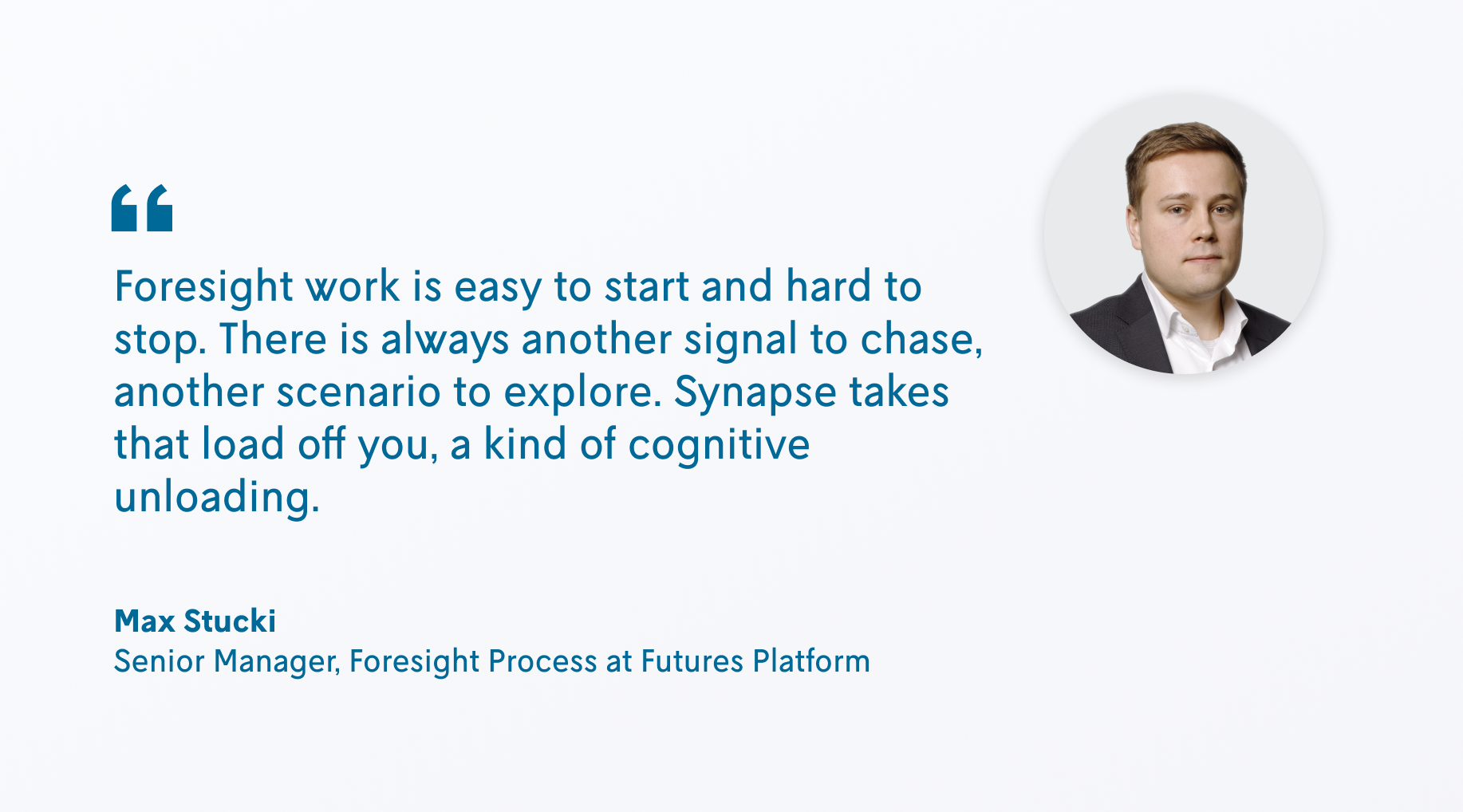
"You can do all of this by hand if you want to," Max says. "It just takes a very long time. The real value is less about pace than about where it lets you put your attention. Foresight work is easy to start and hard to stop. There is always another signal to chase, another scenario to explore. Synapse takes that load off you, a kind of cognitive unloading. It frames the exploration, scans the horizon, and surfaces the key signals, trends, and drivers of change.”
However, none of this takes the work out of your hands. You can edit at any point in the sense-making flow, from the sources Synapse selects to how it reads them. That keeps you in the loop throughout, and it makes the process more transparent. You can see which source an insight came from, allowing you to trace the references behind the tool's output. If a source it flagged as relevant doesn’t fit your context, you change it. If there is material of your own you want considered, you upload it into your workspace, and Synapse works with that too.
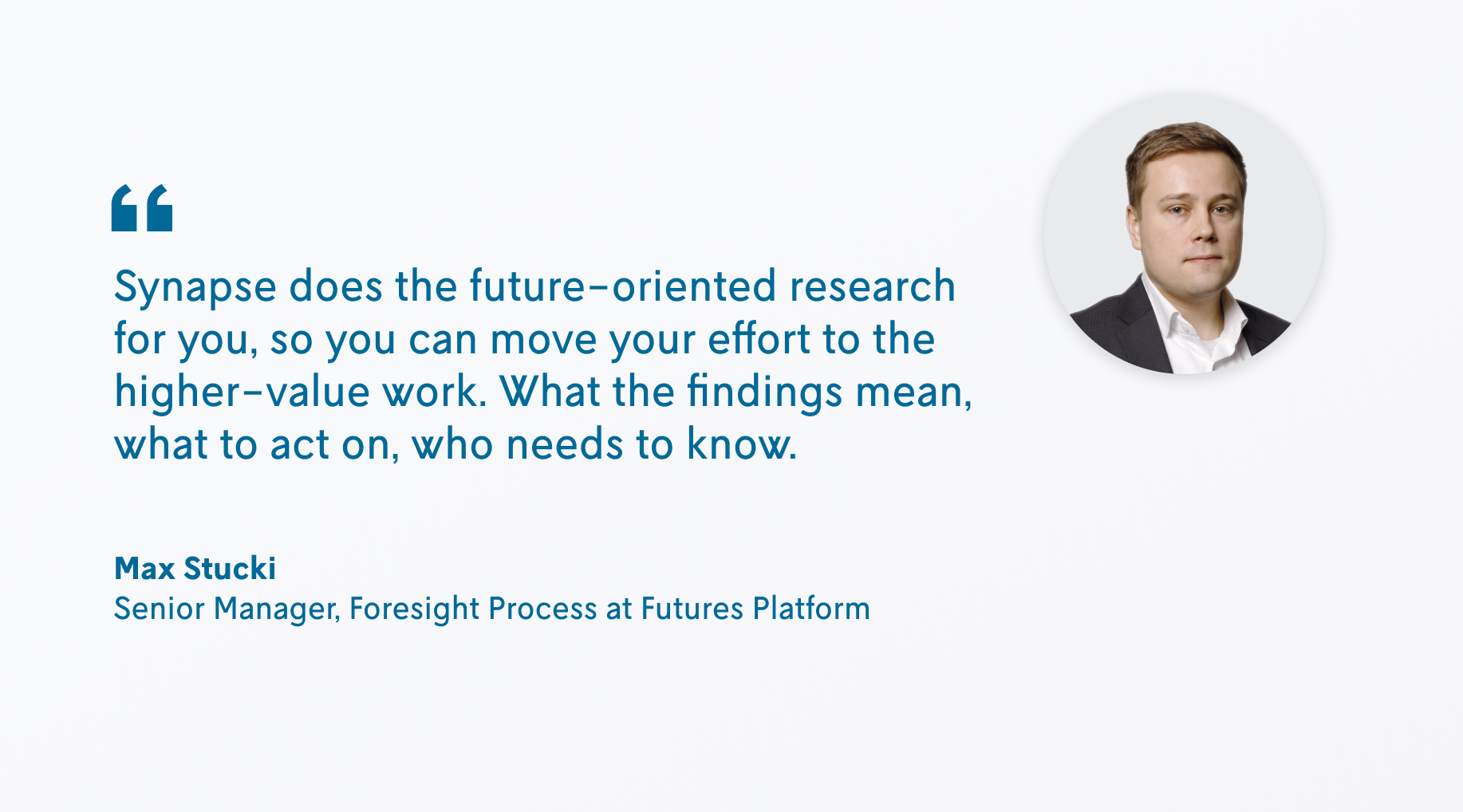
"Synapse does the future-oriented research for you, so you can move your effort to the higher-value work. What the findings mean, what to act on, who needs to know," Max adds.
Rigour at speed and scale
Running a method this quickly raises an obvious worry. Does the rigour survive?
The answer, Max says, is mostly in the preparation. "You have to translate the method very clearly, then test it many times until the results hold up across runs. There is some trial and error. But if you define the method well, you are already ninety-five per cent there."
The harder part is quality. An AI model will produce something for almost any prompt, confidently and fast. Knowing whether that something is actually good foresight is the real challenge, and it is one the team took seriously enough to build for.
"AI will quickly do almost anything," Marianna says. "The harder part is being sure it is doing what we actually want, and that it is valuable for foresight. So we built ways to evaluate that."
Their entire approach reflects that caution. Step by step, each step done well, rather than everything at once. It is a slower way to build, and a more trustworthy one.
There is one question anyone using AI for strategic or future-focused work eventually asks: How do you stop the AI from flattening the nuance or producing something generic? Max and Marianna were candid about it. The same language models sit underneath everyone's tools, including theirs. The difference is in the work around the model: studying where general-purpose systems fall short for foresight, then designing the method, the instructions, and the sources to close exactly those gaps.
Where foresight is heading in the age of AI
As AI gets better at researching and estimating, there is a pull toward treating the future as something you can predict. Max names the danger plainly:
"If you drift toward forecasting, you get the illusion that you are in control. You are not. And that is always dangerous."
The distinction matters because the two disciplines do different jobs. Forecasting narrows toward a single expected outcome. Foresight holds several potential futures open, so an organisation can prepare for more than one. Lose that, and you have a confident-looking answer that closes down the very options a team needs to see.
Marianna sees a responsibility in that. The deeper work, she says, is understanding what foresight should look like in this new setting, and building that understanding into the design principles from the start. "If we don't integrate it now, while these tools are being shaped, we risk entering a world of limited alternatives, where strategic foresight is compressed into reactive forecasting."
For all the caution, neither of them is pessimistic about what comes next. The near term, Max says, is simply unsettled. "Everyone is still working out how best to use AI in foresight. The established practices are not clear yet."
Further out, the technology may start to open genuinely new ground. "We may be able to make scenarios far more vivid. To test the future, and maybe even feel and see it, more clearly than we can today," says Marianna.
That reflection is a fitting place to end, because it circles back to the philosophy behind Synapse. It cuts through the noise, helping to structure uncertainty into actionable insights. It brings clarity to what's ahead, maps out multiple paths, and supports decisions that fit. Synapse runs fast and does a great deal of the work. The judgement, still, is yours.
What does future change mean for your organisation?
That's the question most futures tools leave unanswered. Synapse is a Futures Intelligence workspace built specifically to answer it, guiding you from fragmented signals to decision-ready deliverables.
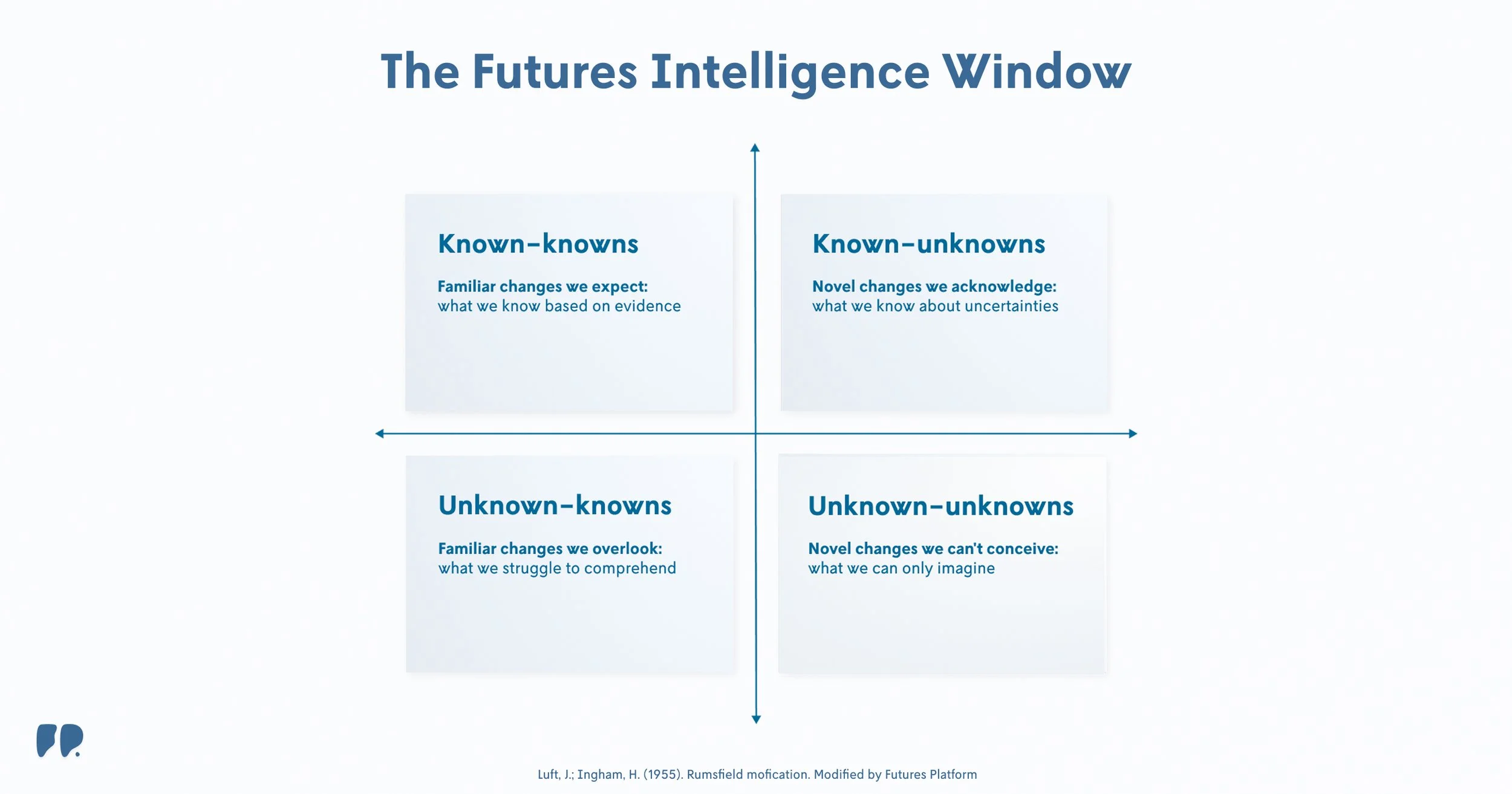

Futures Intelligence is an integrative capability that brings different forms of future-related insights in one connected sense-making flow to turn them into shared, decision-ready understanding. It brings together different types of future-focused knowledge. Used in isolation, each has blind spots. Used together, they build a comprehensive picture of the possible futures ahead.